


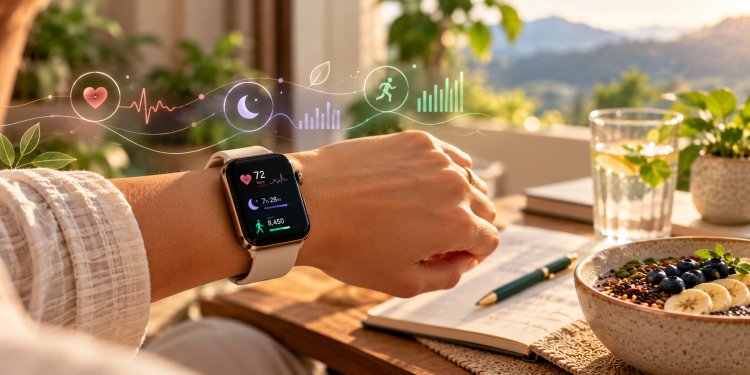
What your smartwatch, smart ring or fitness tracker can—and cannot—tell you about sleep, stress, recovery and metabolic health.
Imagine waking up after what felt like a perfectly good night’s sleep. You feel refreshed and ready for the day. Then you glance at your smartwatch: Sleep score: 62. Recovery: Poor. Suddenly, you begin questioning how you feel. Did I sleep badly? Is my body under stress? Should I skip my workout?
Just a few minutes earlier, you felt fine. But now a number on your wrist has changed how you think about your morning. This is one of the contradictions of modern health technology: we have more information about our bodies than ever before, but does more information mean better health?
Smartwatches, fitness bands and smart rings can help us notice patterns in sleep, movement, heart rate and recovery. They can also generate scores that look precise without telling the whole story. In preventive and lifestyle medicine, the opportunity is to use these measurements as feedback—not as a verdict on how healthy we are.
Your Body Has Always Been Giving You Signals
Long before smartwatches existed, our bodies communicated through everyday signals. We feel tired after inadequate sleep, breathless during exertion, or unusually drained after a demanding week. The cardiovascular, nervous and metabolic systems constantly adjust to activity, illness, hydration, stress and rest.
The challenge is that busy routines can make subtle changes hard to notice. You may believe you sleep eight hours each night, yet discover that your bedtime varies considerably. You may exercise three times a week, but spend most other waking hours sitting. A wearable’s greatest advantage is often making habits visible.
What Is Wearable Health Technology?
Wearable health technology includes devices worn on the body that collect information about movement or physiological signals. Smartwatches, fitness trackers and smart rings may use optical sensors to estimate pulse, accelerometers to detect movement, and other sensors to track temperature or oxygen-related signals. Features and accuracy vary considerably between devices.
An important distinction is that not every number on your screen is directly measured. A heart-rate reading may come from a sensor, whereas a sleep-stage label, stress score or recovery score is usually an algorithmic estimate derived from several signals. A measurement, an estimate and a medical diagnosis are three different things.
Can Your Smartwatch Really Tell You How Well You Slept?
Sleep supports memory, concentration, mood, immune function, physical repair and metabolic regulation. Many wearables estimate sleep duration and timing, while some also estimate periods of light, deep and REM sleep. This can help you recognise a pattern of short nights or inconsistent bedtimes.
However, consumer devices generally infer sleep stages from indirect signals such as movement and heart rate. A clinical sleep study measures additional signals, including brain activity, eye movements and muscle activity. Your wearable’s sleep stages are estimates, not the equivalent of a sleep study. A single low deep-sleep number does not establish a disorder.
For many adults, around seven to nine hours of sleep is a useful general target, although needs vary. Instead of chasing a perfect sleep score, ask whether you are getting enough sleep consistently, whether you feel rested, and whether symptoms such as loud snoring, witnessed breathing pauses or marked daytime sleepiness warrant medical assessment.
What Is Heart Rate Variability (HRV)?
Heart rate variability, or HRV, describes the small differences in time between successive normal heartbeats. Even when your average heart rate is 60 beats per minute, your heart does not necessarily beat exactly once every second. These variations reflect aspects of autonomic nervous-system regulation.
HRV can change with sleep, exercise, illness, alcohol, breathing, medication and many other factors. It also differs between people and depends on how and when it is measured. A higher HRV is not automatically healthier for everyone, and a lower HRV is not a diagnosis of stress or inflammation.
The most useful comparison is often with your own baseline, using similar measurement conditions. If your overnight HRV changes for several days, consider the broader picture: have you been unwell, sleeping less, training harder or feeling unusually fatigued? A single reading rarely explains why it changed.
Does a Low Recovery Score Mean You Should Rest?
Some devices combine HRV, resting heart rate, sleep and other signals into a recovery or readiness score. This may be a helpful reminder to notice how your body responds to demanding days, but it is not a direct measurement of how much recovery your body has completed.
Suppose your watch says your recovery is poor, yet you feel energetic and well. That does not mean you should ignore all data, but neither does it mean you must cancel your plans. Consider your symptoms, recent training, sleep, illness and personal goals. Conversely, a reassuring score does not overrule chest pain, dizziness, fever or significant fatigue. How you feel and your medical context still matter.
Can a Wearable Measure Your Stress?
Stress can affect sleep, appetite, blood pressure and glucose regulation. Some devices use heart rate, HRV and other measurements to estimate physiological arousal. A higher score might occur during a busy workday, strenuous exercise, illness or heat exposure.
But physiological arousal and emotional distress are not identical. Your tracker cannot tell whether you are worried about a family issue, excited about a celebration or rushing for a flight. It cannot measure your thoughts or identify the exact cause of a stress response.
Use recurring patterns as a prompt for reflection. If long meeting days coincide with little movement and poor sleep, try a short walk, a breathing break or a more consistent wind-down routine. Let the reading start a conversation with yourself, not end it.
The Overlooked Benefit: Making Movement Visible
One of the most practical uses of a wearable is also one of the simplest: tracking movement. Step estimates, active minutes and reminders to stand can reveal how much time you spend sitting. They may encourage you to walk between meetings, use the stairs or take a short walk after lunch.
Regular physical activity supports cardiovascular health and insulin sensitivity. But a step count is not a complete picture of fitness. Strength training, balance, flexibility, activity intensity and individual physical limitations also matter. You do not need to hit a universal number every day to benefit from moving more.
If your tracker shows that you are largely inactive during working hours, that may be more actionable than an elaborate recovery score. The best metric is often the one that helps you make a sustainable change.
Why Wearables Matter for Metabolic Health
Metabolic health involves how the body manages glucose, blood pressure and blood lipids, among other processes. Sleep, movement, stress and eating patterns influence these systems over time. Wearables do not measure all aspects of metabolism, but they can make some of the behaviours that support metabolic health easier to observe.
You might discover that your sleep is shorter after late workdays or that you move much less when your calendar is full. Instead of trying to fix every number, choose one experiment: a consistent bedtime, a ten-minute walk after a meal, or short breaks from sitting. Notice whether the habit is realistic and whether you feel better over time.
A wearable cannot independently diagnose insulin resistance, diabetes, fatty liver disease or cardiovascular disease. Depending on age, symptoms and risk factors, clinical assessment may include blood pressure, lipid testing and blood glucose or HbA1c. Tracking habits complements preventive care; it does not replace it.
To learn more about the relationship between your internal clock and nutrition, explore Your Cells Have Office Hours: Why When You Eat May Matter as Much as What You Eat.
What About Continuous Glucose Monitors (CGMs)?
Continuous glucose monitors are a different type of technology. A sensor placed on the body measures glucose in the fluid just beneath the skin and displays patterns over time. CGMs can be particularly useful in diabetes management, where trends, alerts and treatment decisions may have clear clinical relevance.
For people without diabetes, interpreting every small rise and fall is more complicated. Glucose normally increases after meals, and a temporary rise does not automatically indicate disease. Sensor readings also differ from blood glucose measurements, especially during rapid changes.
A CGM may sometimes support a structured, clinician-guided investigation of meal patterns or activity. But the goal is not to achieve a perfectly flat glucose line, nor should a single post-meal reading lead to unnecessary food restrictions. Clinical context and established testing remain important.
To understand how daily habits influence glucose patterns, explore our article The Glucose Roller Coaster: Why Your Energy, Hunger and Cravings Rise and Fall.
Can Wearing a Device Actually Prevent Disease?
Wearables may support prevention indirectly by encouraging behaviours associated with better long-term health, including regular movement, adequate sleep and more consistent routines. Some devices also have specific features that can alert users to potentially important findings, though capabilities and regulatory status vary.
However, owning a smartwatch does not itself prevent disease. The evidence that consumer tracking consistently produces lasting health improvements is still developing, and results depend on the person, device and how the information is used. An alert may require clinical confirmation; the absence of an alert is not a guarantee that everything is normal.
Preventive health still rests on evidence-based habits, appropriate screening, attention to symptoms and individualized medical care. Technology can support those foundations, but cannot substitute for them.
When Health Tracking Becomes Health Anxiety
There is another side to constant monitoring that deserves attention. Some people become so focused on sleep, readiness or glucose scores that the numbers begin to shape their mood. A person who wakes up refreshed may feel anxious after seeing a poor sleep score; someone else may repeatedly check their pulse despite having no symptoms.
More data is not always more reassuring. Consumer measurements can be noisy, and frequent checking can make normal variation seem alarming. If tracking causes persistent worry, disrupted sleep or restrictive eating, it may be time to reduce notifications, check trends less often or take a break from the device.
Good health technology should help you live your life, not make you afraid of ordinary fluctuations.
Five Ways to Turn Health Data Into Healthy Habits
1. Look for trends, not isolated readings. A poor night’s sleep, travel, illness or an unusually intense workout can change a number. Several weeks of consistent patterns are often more informative than one day.
2. Protect your sleep routine. Use bedtime and wake-time patterns to identify opportunities for a more regular schedule. Focus on how you feel and function, not only on estimated sleep stages.
If you often feel sleepy in the evening but suddenly alert at bedtime, read Why Do I Get a Second Wind at Night? The Science Behind Feeling Wide Awake at Bedtime.
3. Break up long sitting periods. Use reminders as gentle prompts to stand, stretch or walk. Choose movement that is enjoyable and appropriate for your health and mobility.
4. Support recovery with everyday basics. Balanced meals, adequate hydration, physical activity, rest and manageable routines matter more than achieving a particular recovery score.
For practical ways to start making those changes, try The 10-Minute Health Experiment: 3 Small Habits That Could Change Your Day.
5. Know when to seek professional guidance. Persistent symptoms, concerning heart rhythm notifications or major changes in your health deserve proper assessment. A wearable is one source of information, not the final answer.
A Simple Seven-Day Wearable Experiment
If you already own a smartwatch or fitness tracker, try using it differently for one week. Rather than checking every score, choose just one habit you want to understand—perhaps sleep consistency or movement during work hours. Record your usual pattern for a couple of days, then make one realistic adjustment.
For example, take a short walk after lunch, keep a more consistent bedtime or step away from your desk every hour. At the end of the week, ask three questions: Did I actually follow the habit? How did I feel? Did the device help me notice anything useful?
Seven days is not enough to establish a medical outcome, and your wearable cannot prove cause and effect. But it can help you practise something more valuable than constant monitoring: turning observation into action.
Dr. Priya’s Insight
In functional and lifestyle medicine, I am interested in the patterns that connect our daily habits with long-term health. Wearable technology offers another window into those patterns. It can reveal that we're sleeping less than we think, sitting for longer than we realise, or recovering differently during a demanding week.
But I would never want a patient to feel that their health is defined by a sleep score, HRV number or readiness percentage. How you feel, your medical history, your symptoms and appropriate clinical screening remain essential. A device may tell you that something has changed; it usually cannot explain the whole reason why.
Let your data guide you, not define you. The goal is not to chase a perfect score or worry about every fluctuation. It is to turn useful information into practical choices—one healthy habit at a time.
Frequently Asked Questions
Are smartwatch sleep scores accurate?
They can help estimate sleep duration and broad patterns, but accuracy varies by device. Sleep-stage estimates are less reliable than a clinical sleep study and should not be treated as a diagnosis.
Is a higher HRV always better?
No. HRV varies with age, physiology, medications, measurement methods and daily circumstances. Trends compared with your own baseline are generally more useful than comparing your number with someone else’s.
Can a smartwatch detect stress?
Some devices estimate physiological stress from heart rate, HRV and other signals. They cannot determine the precise cause of stress or measure your emotional experience directly.
Can a fitness tracker tell me if I have insulin resistance?
No. A wearable may reveal activity or sleep patterns relevant to metabolic health, but insulin resistance requires clinical interpretation and, when appropriate, medical testing.
Should people without diabetes use a CGM?
There is no general requirement for people without diabetes to use a CGM. Its usefulness depends on the clinical question, and individual glucose fluctuations should not be overinterpreted. Discuss whether it is appropriate with a qualified clinician.
What should I do if my watch reports an abnormal heart rhythm?
Follow the device’s instructions and seek appropriate medical assessment. A wearable alert may need confirmation with a medical-grade ECG or other testing. Seek urgent care for symptoms such as chest pain, fainting or severe breathlessness.
Can a wearable improve my health without changing my habits?
Simply wearing a device is unlikely to produce meaningful health improvements. Its potential benefit comes from using the information to support sustainable behaviours and appropriate medical care.
Key Takeaways
Wearables are tools for awareness, not complete assessments of health. They can help identify patterns in sleep, movement, heart rate and aspects of recovery, but many displayed scores are algorithmic estimates.
Patterns matter more than perfect scores. Your baseline, symptoms and circumstances are more useful than reacting to every fluctuation.
Metabolic health is bigger than a dashboard. Sleep, movement, nutrition, stress management and clinical screening still form the foundation of prevention.
The most valuable number is one that helps you take action. If your wearable encourages a sustainable improvement in daily life, it has done something worthwhile.
Beyond the Numbers: The Future of Preventive Health
We are entering an era in which everyday technology can make parts of our physiology more visible. That is exciting. It may help people recognise patterns earlier, ask better questions and participate more actively in their health decisions.
But technology becomes truly useful only when it is interpreted with care. No watch can capture every aspect of your health, and no score can replace the experience of living in your own body. Use the information that helps, question the numbers that do not make sense, and seek medical guidance when needed.
Your smartwatch may know your numbers. The goal is to use them to understand your health—not to let them define it.







Dr. Priya Vasudevan M.D, AB. Dip ABLM