


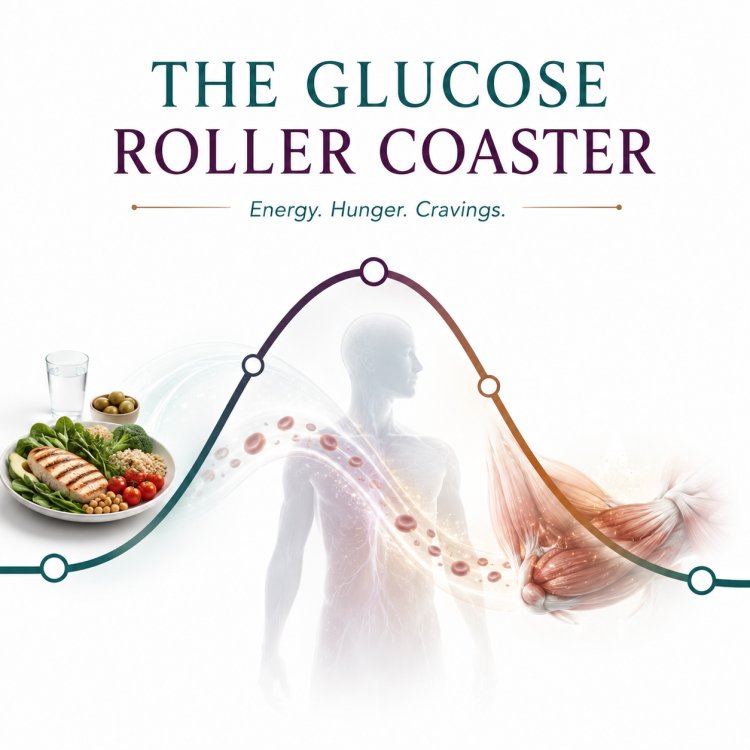
The Glucose Roller Coaster: Why Your Energy, Hunger and Cravings Rise and Fall
We often think of blood sugar as something that matters only to people with diabetes.
But glucose affects all of us.
It is one of the body's most carefully regulated fuels, and the way your blood glucose rises and falls throughout the day can influence your energy, hunger, concentration, mood and metabolic health.
Have you ever eaten breakfast and felt hungry again two hours later?
Or finished lunch feeling energetic, only to hit a wall at 4 PM?
Perhaps you suddenly crave something sweet, reach for coffee, or find it difficult to concentrate.
These experiences can have many causes. But for some people, repeated fluctuations in blood glucose may be part of the picture.
This is what I like to call the glucose roller coaster.
What Happens to Your Blood Sugar After You Eat?
Every meal begins a metabolic journey.
When you eat carbohydrate-containing foods, your digestive system breaks carbohydrates down into glucose. Glucose enters your bloodstream, and your pancreas responds by releasing insulin.
Insulin acts as a metabolic signal, helping tissues such as your muscles and fat take up glucose so that it can either be used for energy or stored for later.
Your blood glucose therefore rises after eating.
And this is important:
A rise in blood glucose after a meal is normal.
We sometimes see social media posts suggesting that every glucose spike is harmful or that healthy people should somehow maintain a perfectly flat glucose curve.
That isn't how human physiology works.
Glucose is supposed to rise after we eat and gradually return toward baseline as tissues use and store that energy. The concern is not an occasional rise. It is a persistent pattern of large glucose excursions, particularly when combined with poor diet quality, inactivity, inadequate sleep or insulin resistance.
Why Does One Meal Cause a Bigger Rise Than Another?
Not all carbohydrate-containing meals affect blood glucose in the same way.
The size and speed of the rise depend on several factors:
• The type of carbohydrate
• How much carbohydrate you eat
• How processed the food is
• The fibre content
• Whether protein is present
• Whether healthy fats are present
• Whether vegetables accompany the meal
A sugary drink, for example, is absorbed very differently from a meal containing vegetables, protein, healthy fats and a minimally processed carbohydrate.
The carbohydrate hasn't suddenly become "good" or "bad."
The context of the meal has changed.
How the Glucose Roller Coaster Begins
Imagine a fairly common day.
Breakfast is high in refined carbohydrates.
A couple of hours later comes a sweetened coffee.
Lunch is another large carbohydrate-heavy meal.
By afternoon, energy starts dropping, so you reach for tea and biscuits or something sweet.
Each time you eat, glucose rises.
Insulin responds.
Glucose then moves from the bloodstream into tissues and blood sugar gradually falls again.
For some people, that fall is accompanied by:
• Hunger
• Tiredness
• Difficulty concentrating
• Irritability
• Cravings for something sweet
And what do we often do when that happens?
We look for another quick source of energy.
Something sweet.
Another coffee.
A biscuit.
A snack.
Glucose rises again.
The cycle can become:
Rapid rise → insulin response → glucose decline → hunger or cravings → quick energy → another rise.
That's the glucose roller coaster.
But Carbohydrates Are Not the Enemy
This is where discussions about blood glucose often go wrong.
The solution is not necessarily to eliminate carbohydrates.
Carbohydrate-containing foods can provide energy, fibre, vitamins, minerals and other valuable nutrients.
What matters is the quality, quantity and context in which those carbohydrates are eaten.
The same amount of carbohydrate can produce different glucose responses depending on what accompanies it.
Protein and healthy fats can influence how quickly nutrients leave the stomach and reach the bloodstream. Fibre can slow carbohydrate digestion and absorption, particularly when it comes from minimally processed plant foods.
Think about the difference between:
Eating a piece of fruit by itself
and
Eating fruit alongside a protein-rich food.
Or:
Drinking a sugary beverage
and
Eating a meal containing vegetables, protein and a sensible portion of whole-food carbohydrate.
The glucose response may be very different.
So instead of asking:
"How do I avoid carbohydrates?"
A better question is:
"How can I build a meal that helps my body handle carbohydrates well?"
What Happens Between Meals?
This is perhaps the most interesting part of the story.
Your body doesn't simply run out of glucose once the food from your last meal has been absorbed.
It has an extraordinarily sophisticated backup system.
As insulin levels fall between meals, your liver begins helping to maintain blood glucose by releasing glucose from stored glycogen.
If the period without food continues, your body gradually increases its use of stored fat and other fuel sources.
In other words, your body is designed to switch between:
Energy coming in from food
and
Energy already stored within the body.
This ability to move appropriately between different fuel sources is called metabolic flexibility.
And it is one of the most important concepts in metabolic health.
Your Body Was Designed to Switch Fuels
Imagine a hybrid car.
It can use one source of energy when that's available and transition to another when needed.
Your metabolism has a similar flexibility.
After eating, nutrients from your meal provide energy.
Between meals, stored energy becomes increasingly available.
A healthy metabolism should be able to transition between these states without leaving you constantly hungry, craving sugar or feeling that you need to eat every couple of hours.
The goal isn't to keep glucose perfectly flat.
The goal is to have a body capable of responding appropriately when glucose rises and efficiently accessing stored energy when it falls.
The Glucose-Regulating Organ We Don't Talk About Enough
When we talk about blood sugar, most people immediately think about the pancreas.
But there is another organ that deserves much more attention.
Your skeletal muscle.
Muscle is one of the body's largest sites for glucose disposal.
When your muscles contract—whether you're exercising, walking or simply moving—muscle cells can take up glucose to help produce energy.
Remarkably, muscle contraction can increase glucose uptake through mechanisms that don't depend entirely on insulin.
This is one reason physical activity can have such an important effect on metabolic health.
Regular resistance training and aerobic exercise can improve insulin sensitivity, helping your body manage glucose more efficiently.
And you don't always need a full workout to make movement useful.
Something as simple as walking after a meal can help.
A gentle 10–15 minute walk after eating is one of the practical strategies recommended in the newsletter to encourage glucose disposal and reduce prolonged post-meal elevation.
You're not trying to "burn off" your meal.
You're simply giving your muscles an opportunity to do what they are exceptionally good at:
Use glucose.
The Glucose Roller Coaster: Why Your Energy, Hunger and Cravings Rise and Fall — Part 2
Sleep and Stress Join the Story
You can eat a reasonably healthy diet and still struggle with blood glucose regulation.
Why?
Because glucose metabolism isn't controlled by food alone.
Inside the cell, nutrients ultimately feed into pathways involved in cellular energy production.
Your sleep, stress levels, physical activity and meal timing are all part of the picture.
Poor sleep can affect insulin sensitivity, appetite-regulating hormones and even the food choices you make the following day.
Chronic psychological stress can also influence glucose metabolism through hormones such as cortisol and adrenaline.
This is why metabolic health cannot simply be reduced to:
"How much sugar did you eat?"
Your body is an interconnected system.
Food matters.
But so do sleep, movement, stress and recovery.
Why Poor Sleep Can Make Healthy Eating Harder
Think about how you feel after a poor night's sleep.
You may wake up tired.
Coffee becomes more appealing.
You may feel hungrier.
Highly palatable foods become harder to resist.
And you may have less motivation to exercise.
So poor sleep can affect metabolic health from several directions at once.
This is why consistently restorative sleep belongs alongside nutrition and exercise when we're trying to improve glucose regulation.
Sometimes improving metabolic health isn't about finding another food to eliminate.
It may be about finally improving your sleep.
Stress Can Affect Your Glucose Too
Stress is another often-overlooked part of the glucose story.
When your brain perceives a threat or challenge, hormones such as cortisol and adrenaline help prepare your body to respond.
This response is useful.
If you need to run from danger, your muscles need readily available energy.
The problem is that modern stress often doesn't involve running anywhere.
It may be:
A difficult workday.
Financial worries.
Family responsibilities.
Constant notifications.
Poor sleep.
Or simply feeling as though there is never enough time.
When psychological stress becomes chronic, these stress pathways can influence glucose metabolism even though the stress itself may have nothing to do with food.
This is another reason why metabolic health needs a whole-body approach.
Are You Actually Hungry—or Just Riding the Roller Coaster?
Many people assume that if they feel hungry, their body must immediately need more food.
Not necessarily.
Hunger is influenced by many things.
Meal composition.
Sleep.
Stress.
Habit.
Food availability.
And the way your glucose and insulin respond to previous meals.
If your day repeatedly consists of refined carbohydrates, sugary drinks and frequent snacks, you may find yourself moving from one quick source of energy to another.
Breakfast.
Snack.
Coffee.
Lunch.
Snack.
Tea.
Dinner.
Dessert.
Another snack.
There may be very little time during the waking day when your body isn't receiving incoming energy.
This doesn't mean snacking is inherently unhealthy.
But it does mean that constant grazing when you're not genuinely hungry may not always be helpful.
The newsletter therefore includes avoiding unnecessary grazing as one of the practical strategies for improving glucose rhythm.
How to Build a More Glucose-Friendly Meal
You don't need a complicated formula.
Start by thinking about the whole plate rather than obsessing over a single nutrient.
Build meals around:
• A good source of protein
• Plenty of vegetables
• Fibre-rich foods
• Healthy fats
• An appropriate portion of carbohydrate
The newsletter also recommends choosing whole or minimally processed carbohydrate sources more often and reducing frequent sugary drinks, sweets and highly refined carbohydrates.
The important word here is appropriate.
There isn't one correct carbohydrate portion for everybody.
Someone who exercises intensely may have very different needs from someone who is sedentary.
A person with normal insulin sensitivity may respond differently from someone with insulin resistance.
Medications matter.
Metabolic health matters.
Activity level matters.
Individual tolerance matters.
This is why personalised nutrition makes more sense than declaring one macronutrient universally "good" or "bad."
A Simple Change: Don't Eat Carbohydrates Naked
This is a useful way to think about meal composition.
Instead of frequently consuming refined carbohydrates or sugary foods on their own, combine carbohydrate-containing foods with protein, fibre, vegetables or healthy fats.
For example:
Fruit with a protein-rich food rather than a sugary fruit drink.
Rice accompanied by vegetables and protein rather than a very large portion of rice with little else.
Whole or minimally processed carbohydrates rather than highly refined alternatives.
The newsletter explains that protein and healthy fats can influence how quickly nutrients reach the bloodstream, while fibre can slow carbohydrate digestion and absorption.
Again, the objective isn't to eliminate glucose rises.
It is to create a more balanced metabolic response.
One of the Simplest Things You Can Do After Eating
Walk.
It sounds almost too simple.
But skeletal muscle is one of the body's major sites for glucose disposal.
A gentle 10–15 minute walk after a meal, when practical, can encourage glucose uptake by muscle and help reduce prolonged post-meal elevation.
You don't need gym clothes.
You don't need a treadmill.
You don't need to "burn off" the calories you just ate.
Walk around your neighbourhood.
Walk around the office.
Walk while taking a phone call.
Take the stairs.
Move your body.
And over the longer term, both resistance training and aerobic activity can help improve insulin sensitivity.
This is why building muscle isn't just about looking stronger.
Muscle is metabolic tissue.
How to Smooth the Glucose Roller Coaster
You don't need to completely redesign your life.
Small, consistent habits can make a meaningful difference.
1. Build balanced meals
Include protein, vegetables, fibre-rich foods and an appropriate amount of carbohydrate.
2. Reduce frequent refined carbohydrates
Sugary drinks, sweets and highly refined foods can be easy to overconsume and may produce faster glucose rises.
3. Choose minimally processed carbohydrates more often
Food structure and fibre influence how quickly carbohydrates are digested and absorbed.
4. Walk for 10–15 minutes after meals when practical
Let your muscles help manage some of the incoming glucose.
5. Build and use your muscles
Include regular resistance training as well as aerobic activity.
6. Stop grazing automatically
Eat when you're genuinely hungry rather than because food happens to be available.
7. Protect your sleep
Consistent restorative sleep is part of glucose regulation.
8. Manage chronic stress
Breathing exercises, meditation, yoga and time outdoors are some of the strategies suggested in the newsletter.
9. Personalise your carbohydrate intake
Your metabolic health, activity level, medications and individual tolerance should guide your needs.
Don't Chase a Perfectly Flat Glucose Line
This is perhaps the most important message in this entire article.
Healthy metabolism does not mean keeping your blood glucose perfectly flat.
Your body is designed to respond dynamically.
You eat.
Glucose rises.
Insulin responds.
Your tissues use and store energy.
Glucose gradually falls.
Between meals, your body begins accessing stored energy.
That's normal physiology.
The real goal is something much more valuable:
Metabolic flexibility.
Your body should be able to move appropriately between incoming dietary energy and stored energy without excessive fluctuations, persistent hunger or impaired glucose regulation.
When this system becomes less responsive, insulin resistance can develop. Over time, impaired glucose regulation may contribute to metabolic syndrome and increase the risk of type 2 diabetes and cardiovascular disease.
Dr. Priya's Insight
Blood glucose is supposed to rise and fall.
The goal isn't to fear every rise.
It's to avoid spending the entire day on a metabolic roller coaster.
A balanced meal can help provide steadier energy and better appetite control.
Movement—particularly after meals—gives your muscles an opportunity to use glucose efficiently.
Good sleep and stress management matter just as much as what's on your plate.
And small habits, repeated consistently, can gradually support better insulin sensitivity and metabolic flexibility.
I don't want people to become afraid of carbohydrates.
And I certainly don't want healthy people staring anxiously at every glucose fluctuation.
I want us to understand what a healthy metabolism is actually designed to do.
Receive energy when food arrives.
Use that energy efficiently.
Store what is needed.
And access stored energy when food isn't available.
That's metabolic flexibility.
And building it doesn't require perfection.
It requires consistency.
Frequently Asked Questions
Is a glucose spike after eating bad?
Not necessarily. A moderate rise in glucose followed by a gradual return toward baseline is a normal physiological response. The concern is a persistent pattern of large excursions, particularly alongside other metabolic risk factors.
Do I need to stop eating carbohydrates to control blood sugar?
No. The newsletter specifically notes that carbohydrates do not need to be eliminated. Food quality, portion size, meal composition and individual metabolic health all influence the glucose response.
Why do I crave sweets a few hours after eating?
For some people, a rapid glucose rise followed by a decline may be accompanied by hunger, tiredness, irritability, difficulty concentrating or cravings for something sweet.
Does walking after meals really help?
Muscle contractions can increase glucose uptake, and the newsletter recommends a gentle 10–15 minute post-meal walk when practical as a simple way to encourage glucose disposal.
Can poor sleep affect blood sugar?
Yes. Poor sleep can affect insulin sensitivity, appetite-regulating hormones and food choices.
Can stress increase glucose?
Chronic psychological stress can influence glucose metabolism through stress hormones including cortisol and adrenaline.
What is metabolic flexibility?
Metabolic flexibility is the body's ability to transition appropriately between using energy from recently consumed food and accessing stored energy between meals.
A Smoother Roller Coaster Starts With Small Habits
You don't need to fear glucose.
You don't need to eliminate every carbohydrate.
And you don't need to chase a perfectly flat glucose curve.
Start with the fundamentals.
Build better meals.
Move your muscles.
Walk after eating when you can.
Sleep well.
Manage stress.
Avoid eating simply because you're bored or because food is constantly available.
And give your metabolism the opportunity to do what it was designed to do:
Adapt.
At Tula Wellness Hub, our Functional and Lifestyle Medicine approach looks beyond individual glucose readings to understand the bigger picture—nutrition, muscle, movement, sleep, stress, metabolic health and the individual's unique needs.
Because the goal isn't simply lower glucose.
It's a healthier, more flexible metabolism.
For people with diabetes, prediabetes, or those taking glucose-lowering medications, significant dietary or meal-timing changes should be individualised with appropriate clinical guidance.









Dr. Priya Vasudevan M.D, AB. Dip ABLM