


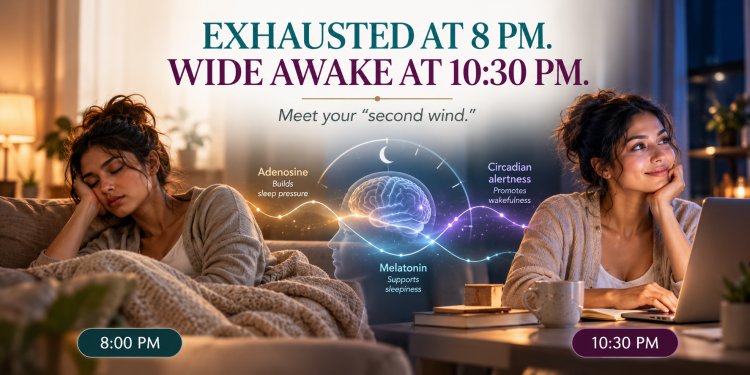
Why Do I Get a Second Wind at Night? The Science Behind Feeling Wide Awake at Bedtime
Why you can feel exhausted in the evening—and suddenly energetic just when you should be sleeping
You were exhausted at 8 PM.
All day, you had been thinking:
“I'm going to bed early tonight.”
Your eyes felt heavy. Your body felt tired. Maybe you even started dozing on the sofa.
Then 10:30 PM arrives.
Suddenly, you're awake.
You want to finish some work. Watch another episode. Organize something. Scroll through your phone. Maybe you suddenly have three good ideas and decide this is the perfect time to act on them.
And you wonder:
Where did all that energy come from?
The interesting answer is:
It may not actually be new energy.
What you're experiencing is often called a “second wind.”
It doesn't necessarily mean that your body has suddenly recovered from the day. Instead, it can result from an interaction between your circadian rhythm, sleep pressure, hormones, light exposure and nervous-system activity.
To understand why this happens, we first need to understand something surprising about sleep.
Being Tired and Being Ready to Sleep Are Not Exactly the Same Thing
We tend to imagine sleepiness as a simple battery.
You're awake all day.
The battery gradually runs down.
Eventually, you're tired enough.
You sleep.
But our biology is more sophisticated than that.
Two major systems help determine when we feel sleepy:
Sleep pressure
and
Your circadian clock.
These two systems usually work together.
But they don't always move in perfect synchrony.
And when they don't, you can end up experiencing something that feels completely contradictory:
“I'm exhausted...but I'm not sleepy anymore.”
Think of Sleep Pressure Like a Balloon Slowly Filling
From the moment you wake up, pressure for sleep gradually begins to build.
One of the molecules involved in this process is adenosine.
Adenosine accumulates in the brain during wakefulness and contributes to our feeling of sleepiness. Generally, the longer we remain awake, the greater this sleep pressure becomes.
Think of it like slowly filling a balloon.
Morning: relatively little pressure.
Afternoon: more.
Evening: more still.
By the end of a long day, that balloon may feel very full.
Which explains why you might be struggling to keep your eyes open at 7 or 8 PM.
But here's where things become interesting.
Your Circadian Clock Has Its Own Opinion
Running alongside sleep pressure is another powerful system:
Your circadian rhythm.
This is your body's internal roughly 24-hour timing system.
It helps coordinate many biological processes and continuously sends information about whether your body should be operating in biological “day” or biological “night.”
We explored this internal timing system in more detail in Your Cells Have Office Hours, including why the timing of everyday behaviours can influence metabolism and health.
And your circadian system doesn't simply say:
“It's dark outside. Time to sleep.”
There can actually be a period in the evening when the circadian system promotes alertness.
That alerting signal helps prevent us from falling asleep too early and supports a more stable sleep-wake rhythm.
Now imagine what's happening inside you.
Your sleep pressure is saying:
“We've been awake all day. I'm tired.”
But your circadian system may temporarily be saying:
“Stay awake a little longer.”
If that alerting signal becomes strong enough relative to your sleep pressure, you may suddenly feel much more awake.
And there it is.
Your second wind.
The Sofa-to-Bed Mystery
This explains one of the strangest nighttime experiences.
You're on the sofa at 8:30 PM.
You can barely keep your eyes open.
You think:
“I should just go to bed.”
But you don't.
You finish something.
You check your phone.
Maybe you watch television for a while.
Eventually, you get ready for bed.
Now it's 10:30 PM.
You lie down.
And suddenly:
You're completely awake.
The newsletter describes exactly this experience: the evening rise in circadian alertness can overlap with accumulated sleep pressure, creating the feeling that you were falling asleep earlier but are suddenly alert when you finally get into bed.
You didn't necessarily “catch up” on your sleep.
Your underlying need for sleep hasn't disappeared.
The balance between the signals affecting your alertness has changed.
But Biology Isn't the Whole Story
There's another reason nighttime can suddenly feel energizing.
Think about your day.
From the moment you wake up, your brain may be dealing with:
Work.
Children.
Messages.
Appointments.
Deadlines.
Decisions.
Traffic.
Conversations.
Responsibilities.
Problems that need solving.
Things other people need from you.
Then the evening becomes quiet.
Nobody needs anything.
The phone stops ringing.
The workday is over.
The house settles down.
And for the first time all day...
your mind has space.
Ideas appear.
You remember something you wanted to read.
You suddenly feel like planning tomorrow.
Or watching something.
Or researching something.
Or simply sitting with your phone without anybody asking you to do anything.
This change in mental stimulation and environment can create the impression that your energy has returned.
If you've ever wondered why prolonged thinking itself can feel exhausting, we explored the biology behind this in Why Your Brain Feels Tired.
For some people, nighttime becomes the first part of the day that feels truly theirs.
And that association itself may reinforce evening alertness.
So your second wind may not always be:
“My body suddenly has more energy.”
Sometimes it may be:
“My brain finally has room to breathe.”
Then We Add Light
Now imagine that during this second wind you pick up your phone.
Or open your laptop.
Or sit under bright indoor lighting.
Light is one of the strongest environmental signals affecting the circadian system.
Bright light in the evening can signal to the brain that it is still daytime.
Evening light exposure can suppress the normal rise in melatonin, a hormone involved in preparing the body for sleep.
Screens are part of the picture, but they aren't the only source.
Phones.
Tablets.
Televisions.
Laptops.
Bright overhead lighting.
All can contribute to an environment that continues to tell your brain:
“We're still active.”
And if this becomes your regular pattern, your brain may gradually receive repeated signals that nighttime is still an active period, contributing to a later feeling of sleepiness.
This is where a second wind can become self-reinforcing.
You feel more alert.
So you stay up.
Because you're staying up, you expose yourself to more light and stimulation.
Which may make it even harder to feel sleepy.
And What About That 4 PM Coffee?
There's another common character in this story.
Caffeine.
Remember the adenosine we talked about earlier—the molecule involved in building sleep pressure?
Caffeine works primarily by blocking adenosine receptors in the brain.
In simple terms, caffeine can reduce your perception of the sleep pressure that has been accumulating throughout the day.
Notice the distinction.
The need for sleep hasn't necessarily disappeared.
You may simply feel it less.
That's why an afternoon coffee can sometimes leave you feeling surprisingly functional late into the evening.
And caffeine doesn't necessarily disappear quickly.
Its half-life varies between people, but caffeine can remain in the body for several hours. So the coffee that seemed completely harmless at 4 PM may still be influencing you around bedtime.
This also explains why copying somebody else's caffeine routine isn't particularly useful.
One person can drink coffee later in the day and seemingly fall asleep without difficulty.
Another may be much more sensitive.
The better question is:
What happens to my sleep when I have caffeine later in the day?
Sometimes the “Second Wind” Isn't Energy at All
There's one more possibility.
You've had an exhausting day.
Your body is tired.
But your mind won't stop.
You replay conversations.
Think about tomorrow.
Remember unfinished work.
Pick up your phone.
Put it down.
Pick it up again.
You're tired...
but somehow wired.
Stress activates systems involving adrenaline, noradrenaline and cortisol that help the body remain alert and responsive.
After a stressful day, you can therefore feel physically exhausted while your nervous system remains activated.
That strange nighttime energy may not actually represent restoration.
It may represent arousal.
Your body may be asking for recovery while your nervous system is still behaving as though something requires your attention.
And that distinction matters.
Because if we interpret every second wind as:
“I guess I'm not tired anymore.”
we may keep pushing bedtime later.
Then something very predictable can begin to happen.
The second wind becomes a cycle.
Why the Second Wind Can Become a Cycle
An occasional second wind is normal.
The problem begins when it repeatedly changes what you do next.
You feel exhausted at 8 PM.
Then you become more alert at 10 PM.
You think:
“I'm awake anyway. I might as well finish this.”
So bedtime moves from 10:30 to midnight.
You sleep later.
The alarm still goes off at the same time.
You wake up tired.
You reach for caffeine to get through the day.
By evening, caffeine, light exposure and your circadian alerting system may make you feel less sleepy again.
Another second wind arrives.
And you stay up late again.
The newsletter describes exactly this pattern:
Tired in the evening → second wind → stay awake → sleep late → wake tired → rely on caffeine → less sleepy in the evening → stay awake late again. 158#Tula Newsletter
Over time, your sleep timing can gradually shift.
Your body begins receiving the same message repeatedly:
Late night is still active time.
And this is why simply saying:
“I need to go to bed earlier.”
may not always solve the problem.
You also need to look at the signals you're giving your biological clock.
Don't Fight Your Biology. Change the Signals.
When people struggle with sleep, there's often enormous focus on bedtime.
“What time should I go to bed?”
But bedtime is only one part of the story.
Your circadian system is responding to signals throughout the day.
The newsletter highlights several practical ways to support those signals: keep your wake-up time relatively consistent, get natural light in the morning, reduce unnecessary bright light late at night, avoid caffeine too close to bedtime and create a transition between work and sleep.
None of these is particularly dramatic.
That's the point.
Sleep is often supported by rhythm rather than hacks.
Start With Your Morning, Not Your Bedtime
One of the most useful things you can do for your body clock happens long before you get into bed.
Wake up at a relatively consistent time.
Your sleep-wake system responds to regularity.
Then give your brain another useful signal:
Morning light.
Natural light helps reinforce the distinction between biological day and biological night.
So when we're trying to improve sleep, it makes sense to think beyond:
“What should I do at 10 PM?”
and also ask:
“What signals did my body receive at 7 AM?”
Your day and night are not biologically separate events.
They are parts of the same rhythm.
Make Night Look Different From Day
Modern life has made something very unusual possible.
At 10 PM, our environment can look almost exactly like 2 PM.
Bright overhead lights.
Television.
Laptop.
Phone.
Messages.
Work.
Entertainment.
Constant stimulation.
But if we want the brain to recognize that night has arrived, it helps when our environment begins to reflect that.
That doesn't mean your house needs to become completely dark after sunset.
It means gradually reducing unnecessary brightness and stimulation as bedtime approaches.
The newsletter notes that evening light can suppress the normal evening rise in melatonin and contribute to a delayed feeling of sleepiness.
So rather than obsessing only about “blue light,” think more broadly:
How much light and stimulation am I giving my brain at night?
Look at Your Caffeine Timing
If you're repeatedly getting a second wind, caffeine is worth examining.
Not because coffee is inherently bad.
But because timing matters.
Caffeine can reduce your perception of accumulated sleep pressure by blocking adenosine receptors, and its effects can persist for several hours.
So instead of asking:
“Is coffee healthy?”
ask a more useful question:
“Is the timing of my caffeine affecting my sleep?”
Notice your own pattern.
Does the second wind happen more often after a late-afternoon coffee?
Do you fall asleep later?
Does your mind feel more alert at bedtime?
Individual responses vary, which makes your own pattern particularly useful information.
Give Your Brain a Landing Strip
For many people, the day doesn't actually end.
It simply collides with bedtime.
One minute:
Emails.
Work.
WhatsApp.
Planning.
News.
Scrolling.
Problems.
The next minute:
“Okay brain, sleep now.”
But the newsletter highlights the importance of giving yourself a transition period between work and sleep.
Think of it as a landing strip.
Your nervous system needs an opportunity to move from:
doing
toward:
resting.
That transition will look different for different people.
The important principle is not creating a perfect nighttime routine.
It's creating a recognizable change of pace.
Pay Attention to When Your Second Wind Appears
This may be the most useful experiment of all.
Don't simply notice that you became energetic.
Notice what happened immediately before it.
The newsletter suggests asking:
Was it after scrolling?
After an evening coffee?
After stressful work?
After exercising late?
Or simply when the house finally became quiet?
Those are very different situations.
And they may require very different solutions.
If it consistently happens after caffeine, look at caffeine timing.
If it happens when you start scrolling, look at evening light and stimulation.
If it happens after stressful work, your nervous system may need more transition time.
If it happens the moment everyone else goes to bed, perhaps nighttime has become the only time that feels like your own.
The pattern can tell you more than the symptom itself.
What If Nighttime Is the Only Time That Feels Like Yours?
This deserves special attention.
Sometimes staying awake late isn't simply a sleep problem.
The evening may be the first time all day when nobody wants anything from you.
No meetings.
No patients.
No children asking questions.
No deadlines.
No decisions.
No responsibilities demanding an immediate response.
Finally:
Your time.
So naturally, you don't want to give it up by going to sleep.
The newsletter describes how nighttime can become the first part of the day that feels truly “theirs” for some people, and how that association itself can reinforce evening alertness.
If that sounds familiar, the solution may not simply be:
“Have more discipline and go to bed.”
It may also be worth asking:
“Do I have any space during my day that actually feels like mine?”
Because sometimes what looks like resistance to sleep may also reflect a desire for autonomy, quiet or mental space.
Small, repeatable behaviours can have surprisingly meaningful effects over time. That's the same idea behind The 10-Minute Health Experiment—using simple daily habits rather than trying to overhaul everything at once.
Dr. Priya’s Insight
A nighttime second wind does not necessarily mean your body has suddenly discovered a hidden reserve of energy.
Sometimes your circadian clock is temporarily promoting alertness.
Sometimes caffeine is masking accumulated sleep pressure.
Sometimes evening light is delaying the biological signals that prepare you for sleep.
And sometimes your nervous system has finally escaped the demands of the day and becomes mentally stimulated.
I think this is an important shift in how we think about sleep.
Instead of asking:
“Why won't my body sleep?”
ask:
“What signals is my body receiving?”
Your body isn't necessarily working against you.
It is responding to its environment.
The goal isn't to force sleep.
It's to create an environment in which your biological clock has fewer reasons to stay awake.
Because:
Good sleep isn't simply about being tired enough.
It's also about giving your body the right signals at the right time.
A Simple Second-Wind Check
If you suddenly become wide awake tonight, don't immediately decide:
“I guess I'm not tired.”
Instead, ask:
How late did I have caffeine today?
Have I been under bright lights?
Have I been scrolling or working?
Was today particularly stressful?
Did I become more alert once the house became quiet?
Have I been going to bed later over the past few days?
Is my wake-up time changing considerably from day to day?
You're not trying to diagnose yourself.
You're looking for patterns.
Because when it comes to sleep:
The pattern can often tell you more than one difficult night.
Frequently Asked Questions
Why do I suddenly get energy at night?
A nighttime “second wind” can result from an interaction between accumulated sleep pressure, the circadian alerting system, light exposure, caffeine, psychological stimulation and nervous-system arousal. It doesn't necessarily mean your body has recovered from being tired.
Why was I sleepy earlier but wide awake when I went to bed?
Sleep pressure and your circadian clock don't always align perfectly. An evening circadian alerting signal can temporarily increase wakefulness even when you have accumulated significant sleep pressure.
What is sleep pressure?
Sleep pressure is the biological drive for sleep that generally increases the longer you remain awake. Adenosine is one of the molecules involved and accumulates in the brain during wakefulness.
Can caffeine cause a second wind at night?
It can contribute. Caffeine blocks adenosine receptors and can reduce your perception of accumulated sleep pressure. Because its effects can persist for several hours, late-afternoon caffeine may still influence you around bedtime.
Can stress make me feel tired but wired?
Yes. Stress-related systems involving adrenaline, noradrenaline and cortisol can promote alertness. This can leave someone physically exhausted while still feeling mentally activated.
Can my phone make me feel more awake at night?
Phones can contribute through both light exposure and stimulation. Evening light can interfere with the normal rise in melatonin, while scrolling or engaging content can also keep the brain mentally active. The newsletter emphasizes that screens are not the only source—bright indoor lighting can contribute too.
How can I reduce my nighttime second wind?
Rather than trying only to force an earlier bedtime, support the signals involved in sleep: maintain a relatively consistent wake time, get natural light in the morning, reduce unnecessary bright light at night, consider caffeine timing and create a transition between work and sleep.
Key Takeaways
• Feeling tired and being biologically ready for sleep are not exactly the same thing.
• Sleep pressure builds the longer we stay awake, with adenosine contributing to that process.
• Your circadian system can temporarily promote alertness in the evening.
• A second wind doesn't necessarily mean your body has recovered its energy.
• Evening light can delay signals involved in preparing the body for sleep.
• Caffeine can mask accumulated sleep pressure.
• Stress can create a “tired but wired” state.
• Nighttime may also become psychologically stimulating because it is finally quiet and free from daytime demands.
• Repeatedly responding to a second wind by staying awake can gradually reinforce later sleep timing.
• Consistent wake times, morning light, appropriate caffeine timing and a transition into nighttime can help support healthier sleep signals.
Don't Chase the Second Wind
The next time you're exhausted at 8 PM and strangely awake at 10:30 PM, remember:
Your body hasn't necessarily discovered extra energy.
Something may simply have changed the balance between sleep pressure, circadian alertness and nervous-system stimulation.
Instead of chasing that second wind into midnight, become curious about what created it.
Was it light?
Caffeine?
Stress?
Scrolling?
Work?
Or simply the first quiet moment you've had all day?
Your body isn't working against you.
It's responding to the signals it receives.
And better sleep may begin not by forcing yourself to sleep...
but by giving your body the right signals at the right time.








Dr. Priya Vasudevan M.D, AB. Dip ABLM