


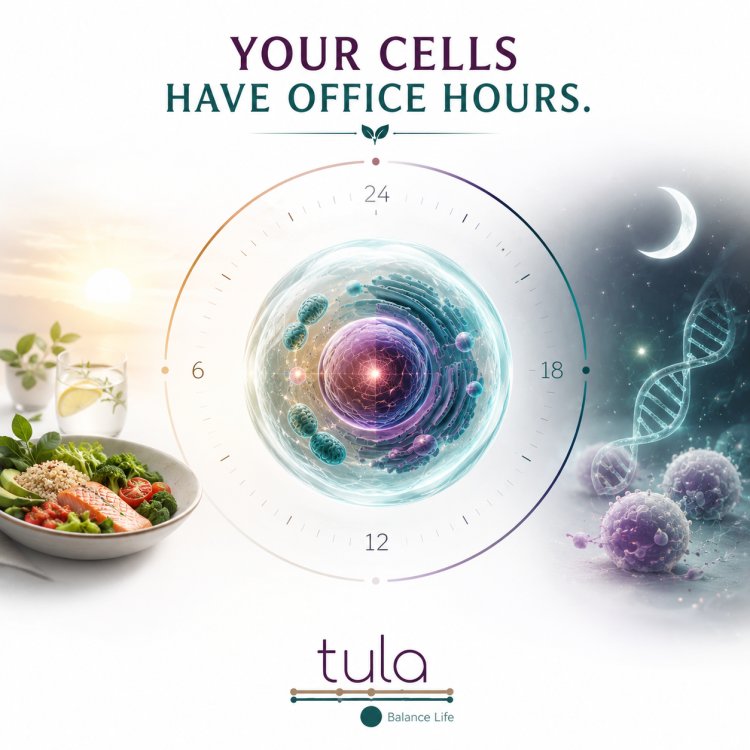
We spend a lot of time thinking about what we eat.
Are we getting enough protein?
Enough fibre?
Enough vitamins and minerals?
Should we eat more healthy fats?
Should we cut down on carbohydrates?
These are important questions.
But there is another question we rarely ask:
When does your body receive that food?
A nutritious meal doesn't enter a body that operates exactly the same way 24 hours a day.
Your hormones change throughout the day.
Your metabolism changes.
Your digestion changes.
Your sensitivity to insulin changes.
Even the way your cells use nutrients changes.
In other words:
Your cells have office hours.
The same meal eaten at 1 PM and 11 PM may not necessarily produce exactly the same biological response.
Why?
Because your body runs according to an internal clock.
Your Body Runs on a 24-Hour Schedule
Almost every cell in your body contains molecular clocks that help coordinate its activities with the cycle of day and night.
Together, these rhythms form part of your circadian system.
Your circadian rhythm helps regulate:
- Sleep and wakefulness
- Hormone production
- Body temperature
- Blood pressure
- Digestion
- Metabolism
- Cellular activity
During daylight hours, the body is generally more prepared for activity, food intake, digestion and nutrient utilisation.
As evening approaches, the biological emphasis gradually shifts.
Instead of activity and feeding, the body begins preparing for restoration, repair and sleep.
This doesn't mean your digestive system suddenly switches off when the sun goes down.
It means that your physiology is not identical at every hour of the day.
And that distinction matters.
The Same Food. A Different Response.
Imagine eating exactly the same carbohydrate-rich meal twice.
One at lunchtime.
The other very late at night.
The calories haven't changed.
The carbohydrates haven't changed.
But your body's response may be different.
One reason is insulin sensitivity.
Insulin helps move glucose from your bloodstream into your cells.
Insulin sensitivity generally tends to be better earlier in the day than late at night. As a result, identical amounts of carbohydrate may not always produce identical metabolic responses depending on when they are consumed.
This is where nutrition becomes more interesting.
We aren't only asking:
What did you eat?
We're beginning to ask:
When did you eat it?
Welcome to Chrononutrition
There is actually a scientific field studying this relationship.
It's called chrononutrition.
Chrononutrition explores how the timing of food intake interacts with our biological rhythms and metabolism.
Protein still provides amino acids.
Carbohydrates still influence glucose, insulin and glycogen.
Fats still contribute to energy storage, cell membranes and hormone production.
But the body's ability to process and utilise those nutrients isn't completely static throughout the day.
So good nutrition may eventually become more personalised than simply:
"What should I eat?"
It may become:
"What should I eat, how much should I eat—and when is my body best prepared to use it?"
So…
Is Breakfast Really the Most Important Meal?
We've all heard the phrase:
"Breakfast is the most important meal of the day."
But that's probably the wrong question.
A more useful question is:
Where does your eating window fit within your biological clock?
For some people, concentrating more of their food intake earlier in the day may support better glucose regulation and appetite control.
On the other hand, eating very large meals late at night—particularly close to bedtime—may work against normal metabolic and sleep rhythms.
But this does not mean everyone needs breakfast at 7 AM.
And it doesn't mean food suddenly becomes unhealthy after a particular hour.
Your:
- Work schedule
- Sleep pattern
- Exercise routine
- Medications
- Health conditions
- Lifestyle
all matter.
The bigger principle is much simpler:
Try not to give your body its heaviest nutritional workload when many of its metabolic systems are naturally winding down.
What Happens When Food and Your Body Clock Disagree?
Modern life makes it incredibly easy to eat at almost any hour.
Late dinners.
Midnight snacks.
Constant grazing.
Irregular work schedules.
Weekend sleep-ins.
Artificial light.
Phones and television late into the night.
One late dinner isn't the problem.
The concern is chronic misalignment.
When eating, sleeping and physical activity repeatedly happen at times that conflict with the body's circadian signals, metabolic regulation may become less efficient.
Research into circadian misalignment has linked disrupted timing with changes in glucose metabolism, appetite regulation, cardiovascular function and other aspects of health.
Your body likes rhythm.
Modern life often gives it chaos.
Your Cells Also Have a Night Shift
Here's where this becomes even more fascinating.
When you go to sleep, your body doesn't simply shut down.
Quite the opposite.
Important maintenance work begins.
During sleep:
- Hormonal signalling changes
- Tissues undergo repair
- Immune activity is regulated
- The brain participates in clearing metabolic waste
And when you're not continuously eating, nutrient-sensing pathways also change.
Processes associated with cellular maintenance and recycling—including autophagy—become more relevant as nutrient availability falls.
This does not mean fasting magically "detoxes" your body.
And longer fasting isn't automatically better.
Instead, feeding and fasting create different biological environments.
Your body needs periods when nutrients are available.
But it also benefits from periods when it isn't receiving continuous nutritional stimulation.
There is a time to nourish.
And there is a time to maintain and repair.
Perhaps good health depends partly on allowing space for both.
Your Body Likes Predictability
One of the simplest things we can do for our metabolism may be surprisingly unglamorous:
Give the body a rhythm.
Eating at relatively consistent times.
Getting daylight in the morning.
Being physically active during the day.
Avoiding habitual late-night eating.
Maintaining a reasonably consistent sleep schedule.
Allowing periods when you're not continuously eating.
These behaviours repeatedly tell your internal clocks:
This is when we eat.
This is when we move.
This is when we rest.
The goal isn't perfection.
It's predictability.
Constant Grazing May Be Working Against You
Modern nutrition has created an unusual situation.
For many people, eating begins shortly after waking and continues almost until bedtime.
Breakfast.
Coffee with sugar.
A mid-morning snack.
Lunch.
Tea and biscuits.
An evening snack.
Dinner.
Something sweet while watching television.
The body may spend much of the waking day receiving repeated nutritional signals.
But feeding and fasting create different biological environments.
Periods without food allow nutrient-sensing pathways to shift towards cellular maintenance and recycling processes.
That doesn't mean you need extreme fasting.
It simply means your body doesn't necessarily need to be processing food every waking hour.
What About Overnight Fasting?
For many people, one of the easiest ways to create a period without continuous nutritional stimulation is simply to stop eating after dinner and resume eating the following morning.
No complicated fasting protocol.
No obsession with the clock.
Just a reasonable overnight period without food.
The exact duration doesn't need to be identical for everyone.
Your health conditions, medications, activity level and individual nutritional needs matter.
The goal isn't:
"How long can I fast?"
A better question is:
"Am I giving my body some predictable time when I'm not continuously eating?"
Morning Light Matters Too
Chrononutrition isn't only about food.
Your internal clocks respond to environmental signals, and one of the most powerful is light.
For most of human history, sunrise meant activity.
Sunset meant slowing down.
Today, those boundaries have become blurred.
We may spend the morning indoors and the evening surrounded by artificial light, televisions, laptops and phones.
Getting daylight exposure in the morning and being physically active during the day are simple ways of reinforcing the body's natural day-night signals.
Meal timing, movement, light and sleep are therefore not completely separate behaviours.
Together, they help tell your body what time it is.
Should You Stop Eating After 7 PM?
Not necessarily.
This is where health advice can become unnecessarily rigid.
There is no universal rule saying that food suddenly becomes harmful after 7 PM.
Someone who sleeps at 9:30 PM has a very different schedule from someone who works until 9 PM and sleeps after midnight.
A nutrient-dense meal at 8 PM doesn't suddenly become unhealthy because the clock changed.
The more useful principle is to avoid making large, late-night meals and constant nighttime snacking your normal pattern, particularly close to bedtime.
Chrononutrition should help us understand our biology.
It shouldn't make us afraid of the clock.
Food Quality Still Comes First
This point is extremely important.
A perfect eating schedule cannot compensate for a poor diet.
Ultra-processed food eaten at 10 AM doesn't become healthy because you've timed it perfectly.
And a nutrient-rich dinner eaten at 8 PM doesn't automatically become unhealthy because it's "late."
Food quality remains fundamental.
Your foundation should still include:
- Adequate protein
- Plenty of fibre
- Vegetables and fruits
- Healthy fats
- Sufficient micronutrients
- Appropriate energy intake
- Minimally processed foods
Think of timing as another layer of nutrition.
First, improve what you eat.
Then consider when you eat it.
6 Simple Ways to Work With Your Biological Clock
You don't need a complicated chrononutrition programme.
Start with the basics.
1. Eat at Relatively Consistent Times
Your meals don't need to occur at exactly the same minute every day.
Aim for a reasonably predictable eating pattern.
2. Avoid Habitual Late-Night Eating
An occasional late dinner isn't the problem.
Repeatedly eating large meals or snacks close to bedtime may work against your body's natural metabolic and sleep rhythms.
3. Allow a Natural Overnight Break From Food
You don't necessarily need aggressive intermittent fasting.
Simply reducing continuous eating from early morning until bedtime can create a more defined feeding and fasting rhythm.
4. Get Morning Daylight
Morning light provides an important signal to your circadian system that the active part of the day has begun.
5. Move During the Day
Physical activity provides another signal that supports the distinction between daytime activity and nighttime restoration.
6. Protect Your Sleep Schedule
Eating rhythm and sleep rhythm work together.
A consistent bedtime, morning daylight and predictable meals help reinforce the body's internal timetable.
The Future of Nutrition May Include Time
Nutrition has traditionally focused on three questions:
What should I eat?
How much should I eat?
What should I avoid?
Perhaps there is a fourth question:
When is my body most prepared to use what I eat?
Chrononutrition is still an evolving field, and not every claim about meal timing has been proven.
Different people also have different biological, medical and lifestyle circumstances.
But the underlying concept is compelling.
Your body isn't a machine operating identically every hour.
It is a rhythmic biological system.
Perhaps good nutrition isn't only about supplying the right materials.
It's also about delivering those materials at a time when the body is ready to put them to work.
Dr. Priya's Insight
Your cells don't simply ask:
"What did you eat?"
They're also responding to:
"When did you eat?"
The body has periods for activity and periods for restoration.
Moments of nutrient abundance and moments of scarcity.
Phases of construction and phases of maintenance.
We cannot control every biological rhythm within us.
But we can influence some of the signals that shape them.
Consistent meals.
Daylight.
Movement.
Rest.
Sleep.
Periods without food.
These may seem like ordinary lifestyle habits, but together they send a powerful message to our biology:
This is when we eat.
This is when we move.
This is when we rest.
And when the timing of our lifestyle begins to respect the timing of our biology, health may become less about constantly doing more—and more about doing the right things at the right time.
Frequently Asked Questions
What is chrononutrition?
Chrononutrition is the study of how the timing of food intake interacts with the body's biological rhythms and metabolism.
Is it better to eat earlier in the day?
For some people, concentrating more food intake earlier in the day may support glucose regulation and appetite control. Individual sleep patterns, schedules, medications, exercise and health conditions also need to be considered.
Is eating after 7 PM unhealthy?
There is no universal 7 PM rule. The bigger concern is habitual large meals and frequent eating late at night, particularly when this conflicts with normal sleep and circadian rhythms.
Do I need to practise intermittent fasting?
Not necessarily. The principle discussed here is not about prolonged fasting. It is about recognising that periods of feeding and periods without continuous nutritional stimulation create different biological environments.
Is meal timing more important than food quality?
No. Food quality remains fundamental. Meal timing should be viewed as an additional layer of good nutrition—not a replacement for it.
Key Takeaways
- Your metabolism follows a circadian rhythm.
- The body may respond differently to the same nutrients at different times of day.
- Insulin sensitivity generally tends to be better earlier in the day.
- Habitual late-night eating and irregular schedules may contribute to circadian misalignment.
- Your body needs both periods of nourishment and periods without continuous food intake.
- Morning daylight, daytime movement, consistent meals and regular sleep reinforce your biological clock.
- Food quality remains more important than achieving a "perfect" eating schedule.
- The goal is not perfection. It is predictability.
Don't Just Ask What You're Eating.
Ask When.
Healthy nutrition isn't about becoming obsessed with another set of rules.
It's about understanding your biology.
At Tula Wellness Hub, our Functional and Lifestyle Medicine approach looks beyond calories and individual nutrients to understand how food, sleep, movement, stress and daily rhythms work together.
Because sometimes better health doesn't require doing more.
It requires helping your body do the right things at the right time.
Continue Your Wellness Journey
Why Belly Fat Is So Hard to Lose
Understand how insulin resistance, stress, sleep and hormones influence abdominal fat.
The Silent Decline: What Happens Inside Your Body as NAD⁺ Levels Fall
Explore what happens to cellular energy and repair as we age.
Book a Functional Medicine Consultation
Get personalised guidance based on your metabolism, nutrition, sleep and lifestyle.








Dr. Priya Vasudevan M.D, AB. Dip ABLM