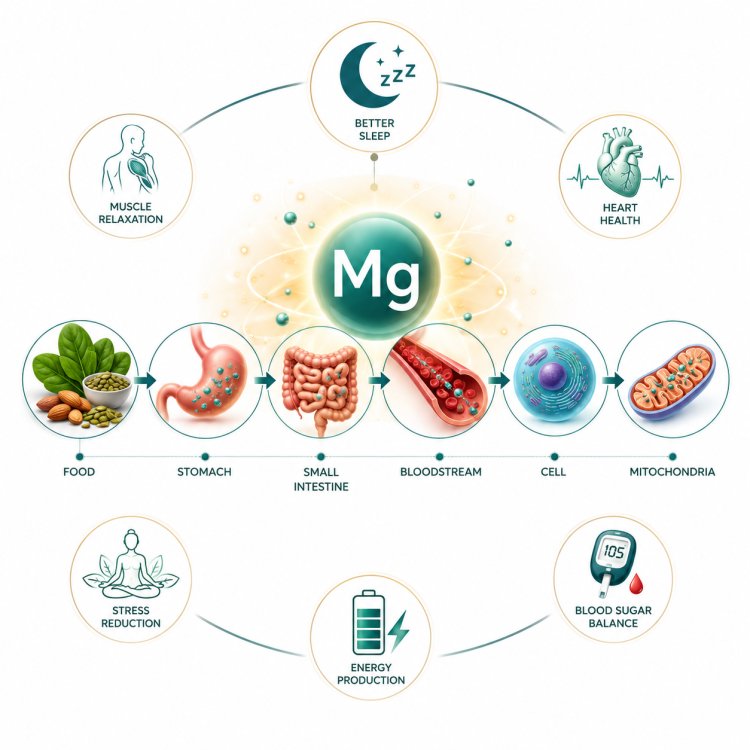
You’ve probably heard that magnesium helps you sleep better, relax your muscles, reduce stress, support heart health, and regulate blood sugar. It’s one of the most talked-about minerals in health and wellness.

But have you ever wondered what actually happens after you eat a handful of almonds or a bowl of spinach?

How does the magnesium in your food travel from your plate to your muscles, brain, heart, and every one of the trillions of cells in your body?

And why do some people still become magnesium deficient despite eating healthy foods?

The journey of magnesium is far more fascinating than most of us realize. Every magnesium atom travels through a remarkable biological pathway involving your digestive system, bloodstream, kidneys, and individual cells before it can perform the hundreds of tasks that keep your body functioning.

Understanding this journey also helps us understand why good nutrition is about much more than simply eating the right foods. It is about digestion, absorption, transport, and utilization.

Let's follow the life of a magnesium atom—from the moment it enters your mouth until it reaches the tiny powerhouses inside your cells.


It All Begins on Your Plate

Magnesium is naturally present in many whole foods, particularly those that come directly from nature.

Excellent dietary sources include:

  • Leafy green vegetables such as spinach
  • Pumpkin seeds
  • Almonds
  • Cashews
  • Legumes
  • Whole grains
  • Dark chocolate
  • Mineral-rich water

One fascinating fact that many people don't know is that magnesium sits at the centre of every chlorophyll molecule, the green pigment that allows plants to capture sunlight and produce energy through photosynthesis. Without magnesium, plants would not be able to convert sunlight into the energy that ultimately nourishes every living creature.

In a sense, every magnesium-rich meal carries a tiny piece of the sun's energy.

But simply eating magnesium-rich foods doesn't guarantee that your body will benefit from them.

Nutrition begins on your plate—but it certainly doesn't end there.


The First Challenge: Digestion

Once food enters your mouth, digestion begins.

After chewing and swallowing, it reaches the stomach, where stomach acid helps break down food and release magnesium from plant tissues and proteins.

The partially digested meal then moves into the small intestine, where the real work of absorption begins.

This is one of the most important stages in magnesium's journey.

Because no matter how healthy your diet is, nutrients that are not absorbed cannot benefit your body.


How Your Intestine Absorbs Magnesium

The lining of your small intestine is remarkably intelligent.

When magnesium intake is plentiful, some magnesium passes passively between intestinal cells.

However, when intake is lower, your body switches to a more efficient system. Specialized transport proteins actively move magnesium across the intestinal wall, helping conserve this valuable mineral.

This ability to adjust absorption based on your body's needs is one of the many examples of the body's remarkable capacity to maintain balance.

Even so, only about 30–50% of the magnesium you consume is actually absorbed under normal circumstances.

The rest simply passes through the digestive tract.


Why Some People Absorb Less Magnesium

Many factors influence how much magnesium your body can absorb.

These include:

  • Poor gut health
  • Digestive disorders
  • Low vitamin D levels
  • Chronic stress
  • Excessive alcohol intake
  • Certain medications
  • Increasing age

This explains why two people eating similar diets may have very different magnesium levels.

Healthy digestion is just as important as healthy eating.

In Functional Medicine, we often say:

"You are not just what you eat—you are what you absorb."


Into the Bloodstream

Once magnesium crosses the intestinal wall, it enters the bloodstream.

Blood now becomes its transport network, carrying it throughout the body.

Surprisingly, however, less than 1% of the body's total magnesium is actually found in the blood at any given time.

This often surprises people because blood tests are commonly used to assess nutrient levels.

Where is the rest?

  • About 60% is stored in your bones, where it contributes to both bone structure and acts as a reserve for times of need.
  • Nearly 39% is found inside muscles and other soft tissues, where it supports hundreds of vital biochemical reactions.

Your body works very hard to keep blood magnesium levels stable.

If dietary intake falls, it may temporarily draw magnesium from bones and tissues to maintain normal blood concentrations.

This is why someone can have a normal blood magnesium level while still having inadequate magnesium stores.


Every Cell Is Waiting

As blood circulates through the body, each organ takes up magnesium according to its own needs.

Your brain uses magnesium to support communication between nerve cells.

Your heart relies on it to maintain a steady rhythm.

Your muscles need magnesium to relax after every contraction.

Your pancreas depends on magnesium for healthy insulin production and glucose regulation.

Meanwhile, inside every cell, magnesium is preparing for its most important job.

Inside the Cell: Magnesium Gets to Work

Once magnesium enters a cell, its real work begins.

Unlike vitamins or minerals that have one or two specific roles, magnesium is involved in more than 300 enzymatic reactions, with some researchers suggesting it may influence over 600 biochemical processes.

Perhaps its most important role is helping your cells produce and use energy.

Every cell in your body runs on a molecule called ATP (adenosine triphosphate)—often referred to as the body's energy currency.

But here's something fascinating.

ATP is biologically active only when it is bound to magnesium.

In other words, your body doesn't really use ATP.

It uses magnesium-ATP.

Without adequate magnesium, your cells may produce energy less efficiently, which helps explain why magnesium deficiency is often associated with fatigue and reduced exercise tolerance.


The Silent Manager of Your Body

Imagine a large company.

There is the CEO, department heads, and employees who receive most of the attention.

But behind the scenes is an operations manager who quietly ensures that everything runs smoothly.

Without that person, productivity falls, communication breaks down, and problems begin appearing everywhere.

Magnesium plays a similar role inside the human body.

It rarely receives attention, yet it quietly supports:

  • Energy production
  • Muscle relaxation
  • Nerve signalling
  • Protein synthesis
  • DNA repair
  • RNA production
  • Hormone regulation
  • Blood sugar control
  • Heart rhythm
  • Antioxidant defence

It doesn't take centre stage.

It simply makes hundreds of essential processes work properly.


Why Magnesium Deficiency Is Easy to Miss

Unlike vitamin deficiencies that produce dramatic symptoms, magnesium deficiency often develops slowly over months or even years.

The body works hard to maintain blood magnesium levels by drawing magnesium from bones and tissues whenever intake falls.

This is why deficiency can remain hidden despite apparently "normal" blood tests.

Early symptoms are often subtle and easily dismissed as part of modern life.

These may include:

  • Fatigue
  • Muscle cramps
  • Eyelid twitching
  • Headaches
  • Constipation
  • Anxiety
  • Difficulty sleeping
  • Increased stress sensitivity
  • Reduced exercise tolerance
  • Occasional heart palpitations

These symptoms can have many possible causes, but persistent or unexplained symptoms deserve a proper medical evaluation rather than simply self-prescribing supplements.


The Kidneys: Magnesium's Final Gatekeepers

Eventually, every magnesium atom reaches the kidneys.

These remarkable organs constantly filter your blood, making thousands of tiny decisions every day.

Should magnesium be kept?

Or should it be removed?

When magnesium intake is low, healthy kidneys conserve as much magnesium as possible.

When intake is abundant, they allow more magnesium to leave through the urine, helping maintain a healthy balance.

This careful regulation is one reason magnesium levels remain relatively stable under normal circumstances.

However, certain conditions can increase magnesium losses faster than the body can replace them.

These include:

  • Chronic stress
  • Excessive sweating
  • High alcohol intake
  • Certain medications
  • Poorly controlled diabetes
  • Prolonged diarrhoea
  • Some kidney disorders

Understanding these factors helps explain why deficiency is not simply about poor diet.

Sometimes the body is losing magnesium faster than it can conserve it.


Why Modern Life Makes Magnesium Deficiency More Common

Our ancestors consumed diets rich in whole foods grown in mineral-rich soils.

Today's environment presents new challenges.

Modern farming practices have gradually reduced magnesium levels in many agricultural soils.

Food refining removes much of the magnesium naturally present in grains.

Ultra-processed foods often contain fewer minerals while increasing the body's physiological stress.

Ironically, stress itself creates another problem.

When we experience chronic stress, our bodies require more magnesium to support normal nervous system function.

At the same time, stress may increase magnesium losses.

It becomes a vicious cycle.

Stress increases magnesium requirements.

Low magnesium makes it harder for the body to cope with stress.

Breaking this cycle requires addressing both nutrition and lifestyle.


Supporting Magnesium's Journey

Improving magnesium status isn't simply about taking a supplement.

It's about supporting every step of the nutrient's journey—from digestion to absorption, transport, and cellular use.

Simple habits that make a difference include:

Eat Magnesium-Rich Foods

Choose foods such as:

  • Spinach
  • Pumpkin seeds
  • Almonds
  • Cashews
  • Legumes
  • Whole grains
  • Dark chocolate
  • Mineral-rich water

Look After Your Gut

A healthy digestive system is essential for absorbing magnesium efficiently.

Supporting gut health through a balanced diet, adequate fibre, good sleep, and management of digestive conditions can improve nutrient absorption.

Maintain Healthy Vitamin D Levels

Vitamin D influences intestinal absorption of several nutrients, including magnesium.

Stay Hydrated

Good hydration supports normal cellular function and healthy kidney regulation.

Exercise Regularly

Regular movement improves metabolic health and supports healthy muscle function without excessively increasing magnesium losses.

Manage Stress

Chronic stress increases the body's magnesium requirements.

Practices such as meditation, deep breathing, yoga, prayer, spending time in nature, and meaningful relationships can help regulate the nervous system.

Supplement Only When Appropriate

Some individuals benefit from magnesium supplementation, but the most suitable form and dose depend on individual circumstances.

Consult a qualified healthcare professional before starting supplements, particularly if you have kidney disease or take medications.


Dr. Priya's Insight

One of the most beautiful lessons magnesium teaches us is that nutrition isn't just about what we eat—it is about what our bodies can actually use.

A handful of spinach or almonds begins an extraordinary microscopic journey.

Before magnesium can relax a muscle, calm a nerve, regulate blood sugar, or help you sleep, it must survive digestion, cross the intestinal wall, travel through the bloodstream, enter the right cell, and finally reach the mitochondria where it helps generate energy.

This reminds us why Functional Medicine focuses on the whole journey.

Healthy digestion, good gut function, balanced hormones, adequate sleep, movement, and stress management all influence whether nutrients can truly nourish our cells.

Health isn't created by food alone.

It's created by everything that allows the body to absorb, transport, and use that food effectively.


Frequently Asked Questions

What foods are highest in magnesium?

Leafy greens, pumpkin seeds, almonds, cashews, legumes, whole grains, dark chocolate, and mineral-rich water are among the best natural sources.


Why isn't all the magnesium I eat absorbed?

Only about 30–50% of dietary magnesium is absorbed under normal conditions. Gut health, vitamin D status, medications, age, alcohol intake, and digestive disorders all influence absorption.


Can I have magnesium deficiency with a normal blood test?

Yes. Less than 1% of the body's magnesium is found in the bloodstream. The body often maintains normal blood levels by drawing magnesium from bones and tissues.


What are the early signs of magnesium deficiency?

Fatigue, muscle cramps, eyelid twitching, headaches, constipation, poor sleep, anxiety, and reduced exercise tolerance may be early signs, although these symptoms are not specific to magnesium deficiency.


Should everyone take a magnesium supplement?

No. Many people can meet their magnesium needs through a balanced diet. Supplementation should be individualized and discussed with a healthcare professional.


Key Takeaways

  • Magnesium begins its journey in whole foods such as leafy greens, nuts, seeds, legumes, and whole grains.
  • Only a portion of dietary magnesium is absorbed, making gut health essential.
  • Less than 1% of the body's magnesium is found in the blood.
  • Magnesium supports hundreds of biochemical reactions, including energy production, muscle relaxation, nerve function, and blood sugar regulation.
  • Chronic stress, alcohol, certain medications, digestive disorders, and modern diets can all contribute to magnesium deficiency.
  • Supporting digestion, nutrition, sleep, movement, hydration, and stress management helps your body make the most of this essential mineral.

Every Nutrient Has a Story

Every meal begins an incredible journey that most of us never see.

From the moment magnesium leaves your plate, it travels through your digestive system, enters your bloodstream, crosses cell membranes, and finally reaches the mitochondria, where it helps power life itself.

This remarkable journey reminds us that health isn't simply about eating healthy foods.

It's about creating a body that can absorb, transport, and utilise those nutrients effectively.

At Tula Wellness Hub, we believe lasting wellness begins at the cellular level. Through Functional and Lifestyle Medicine, we help optimise digestion, nutrition, metabolic health, and lifestyle so that every cell receives what it needs to function at its best.

Because true health isn't just about what you eat—it's about what your body can do with it.

It is about to help produce the energy that powers life itself.