


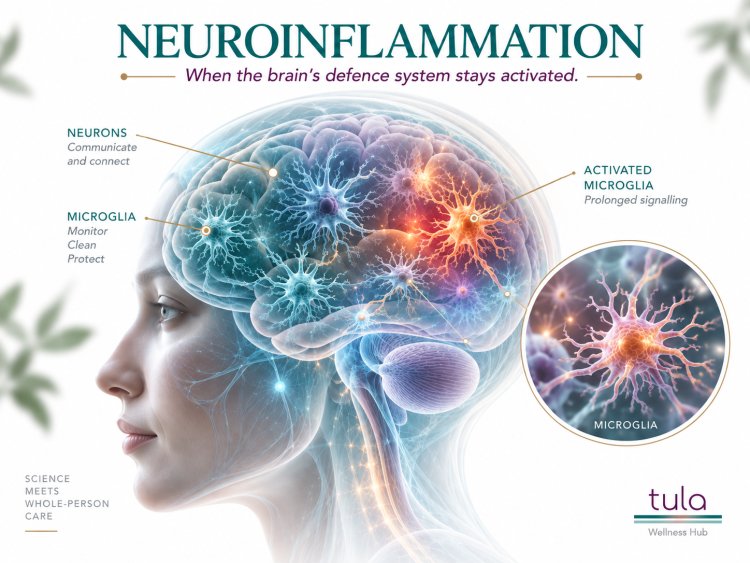
Neuroinflammation: What Happens When the Brain’s Immune System Stays Activated
Understanding Microglia, Brain Inflammation and the Signals That Keep the Brain’s Defences Switched On
When you hear the word inflammation, what comes to mind?
A swollen ankle.
A painful joint.
Redness around a wound.
Perhaps a fever during an infection.
But inflammation can happen somewhere we cannot see or feel directly:
Inside the brain.
This is known as neuroinflammation.
And just like inflammation elsewhere in the body, neuroinflammation is not automatically harmful.
Your brain has its own sophisticated defence system. It is constantly monitoring its environment, looking for signs of infection, injury, damaged cells or unusual activity.
At the centre of this surveillance system are remarkable cells called microglia.
Meet Microglia: Your Brain’s Security and Cleaning Team
Imagine that your brain has a team working quietly in the background 24 hours a day.
Part security guards.
Part cleaners.
Part maintenance crew.
That's a useful way to think about microglia.
Microglia are often described as the immune cells of the brain. They continuously monitor their surroundings, clear away cellular debris, support healthy connections between nerve cells and respond when something appears to be wrong.
Most of the time, you have absolutely no awareness that this is happening.
But suppose there is an infection or brain injury.
Microglia become more active.
They help coordinate a protective response and contribute to clearing damaged material and supporting the surrounding brain tissue.
In that situation, inflammation has a purpose.
It is part of your brain's defence and recovery system.
So What Exactly Is Neuroinflammation?
Neuroinflammation simply means that immune and defence processes within the brain and nervous system have become activated.
It can occur in response to several different situations, including:
• Infections
• Head injuries
• Stroke
• Autoimmune conditions
• Other forms of stress or damage affecting the nervous system
When the brain detects a problem, microglia and other supporting cells can release chemical messengers that help coordinate the response.
These signals may help remove damaged material and support healing.
So once again:
Inflammation isn't necessarily the problem.
The concern is when inflammatory activity continues for too long or becomes poorly regulated.
When the Security Team Doesn't Stand Down
Think back to the fire-alarm analogy from our discussion of chronic inflammation.
When there is danger, you want the alarm.
Your brain works in a similar way.
If something threatens brain tissue, you want your defence system to respond.
But once the immediate problem has been dealt with, you also want that response to settle appropriately.
With prolonged neuroinflammatory activity, the environment surrounding nerve cells can begin to change.
Inflammatory signalling may interfere with communication between brain cells and influence how those cells function.
The same cells that participate in protection can therefore become part of a problem when their activation is prolonged.
It isn't that microglia suddenly become “bad.”
Like chronic inflammation elsewhere in the body, the issue is not the existence of an immune response, but how well that response is regulated.
The issue is regulation.
Neuroinflammation Is Not One Disease
This distinction is extremely important.
Neuroinflammation is being studied in neurological conditions including:
• Multiple sclerosis
• Encephalitis
• Alzheimer's disease
• Parkinson's disease
• Brain injuries
But finding inflammatory activity in these conditions does not mean inflammation plays exactly the same role in all of them.
In some situations, inflammation may contribute to the disease process.
In others, it may partly represent the brain's response to damage that has already occurred.
That means we need to be very careful with statements such as:
“Inflammation causes Alzheimer's.”
Or:
“Reduce brain inflammation and you can prevent neurological disease.”
The relationship is much more complicated than that.
What Can Trigger Brain Inflammation?
Some triggers are relatively straightforward.
An infection.
A brain injury.
A stroke.
An autoimmune reaction.
Certain toxic exposures.
But the brain doesn't exist in isolation from the rest of the body.
What happens outside the brain can also influence the biological environment in which the brain functions.
Long-term metabolic problems, obesity, poor sleep and ongoing inflammation have been associated with changes in inflammatory signalling.
Notice the wording carefully:
Associated with.
That does not mean that one night of poor sleep causes neuroinflammation.
It does not mean that being stressed automatically means your brain is inflamed.
And it does not mean that every person with a metabolic problem has neuroinflammation.
The newsletter specifically cautions against making that leap.
The relationship between the brain, immune system and the rest of the body is complex.
Your Brain Has a Gatekeeper
The brain has another remarkable layer of protection:
The blood–brain barrier.
Rather than allowing substances circulating in the bloodstream to freely enter brain tissue, this specialised barrier carefully regulates what can pass into the brain.
This is one reason we shouldn't think of brain inflammation as simply systemic inflammation that has somehow “spread” into the brain.
The brain has its own highly regulated environment and its own defence mechanisms.
But it is still connected to the health of the rest of the body.
And that brings us to an important question.
Can Neuroinflammation Affect How We Think and Feel?
Potentially—but this is where we need to be especially careful.
Long-lasting inflammatory activity may influence communication between nerve cells, energy metabolism and the cells that support normal brain function.
Depending on the underlying condition, this may be associated with:
• Fatigue
• Difficulty concentrating
• Memory changes
• Changes in mood
It's tempting to read that list and think:
“I have brain fog. Maybe I have neuroinflammation.”
But that's not a conclusion we can make from those symptoms.
Brain fog, tiredness, anxiety, memory problems and difficulty concentrating are extremely nonspecific.
We explored another side of this in Why Your Brain Feels Tired, where we looked at the biology of mental fatigue, cognitive load and brain recovery.
They can occur with:
• Poor sleep
• Psychological stress
• Nutritional deficiencies
• Medications
• Hormonal changes
• Many other medical conditions
So feeling mentally tired does not mean that your brain is inflamed.
And persistent cognitive or neurological symptoms shouldn't simply be labelled “neuroinflammation” without looking for the actual cause.
Sleep: One of Your Brain’s Best Friends
If there is one lifestyle factor that repeatedly appears when we talk about brain health, it is sleep.
Sleep isn't simply the period when your brain shuts down.
Quite the opposite.
Important maintenance processes continue while you sleep.
Sleep helps regulate energy use, supports useful connections within the brain and contributes to processes involved in clearing certain metabolic waste products.
Repeated sleep disruption may also influence inflammatory signalling and microglial activity.
Interestingly, the relationship can go in both directions: health conditions involving inflammation can themselves interfere with sleep.
So protecting sleep is not simply about avoiding tiredness the next morning.
It is part of protecting the environment in which your brain functions.
That means paying attention to basics such as:
A consistent sleep schedule.
A comfortable sleep environment.
Reducing late-night screen exposure.
And investigating persistent sleep problems rather than simply learning to live with them.
Can Food “Switch Off” Brain Inflammation?
No single food can do that.
And I think this is an important message in a wellness environment filled with claims about “brain detoxes” and miracle anti-inflammatory ingredients.
Your brain needs a reliable supply of nutrients.
A balanced dietary pattern containing vegetables, fruits, whole grains, legumes, nuts, seeds and good-quality protein sources can support overall and metabolic health.
Healthy fats from foods such as fatty fish, walnuts, chia seeds and flaxseeds can also form part of a brain- and cardiovascular-supportive eating pattern.
But there is no single food that can simply:
“Switch off neuroinflammation.”
You don't need an extreme detox.
You don't need an unnecessarily restrictive diet.
And taking large quantities of supplements is not the answer.
The more useful principle is:
Think dietary pattern, not miracle ingredient.
Consistency matters more than the latest “superfood.”
Your Brain Is Not Separate From Your Body
This may be the most important idea to take away from Part 1.
We tend to divide the body into separate compartments.
Brain health.
Heart health.
Gut health.
Metabolic health.
Immune health.
But your biology doesn't operate according to those categories.
Your brain depends on blood circulation.
It depends on energy.
It depends on nutrients.
It interacts with your immune system.
And its health exists within the larger metabolic environment of your body.
That's why looking after your brain isn't only about doing crossword puzzles or taking a “brain supplement.”
Sometimes protecting your brain begins somewhere much more familiar:
Sleep well.
Nourish yourself well.
Move your body.
Look after your metabolic health.
And understand that the brain's defence system—like the immune system everywhere else in the body—is designed not simply to remain quiet, but to respond appropriately when needed and regulate that response appropriately afterwards.
Movement Is Brain Medicine Too
When we think about protecting the brain, exercise may not be the first thing that comes to mind.
But the brain is not separate from the cardiovascular and metabolic systems that support it.
Physical activity influences blood flow, insulin sensitivity, mitochondrial function and many of the signalling pathways involved in maintaining healthy tissues.
We've explored the cellular-energy side of this in The Silent Decline: What Happens Inside Your Body as NAD⁺ Levels Fall.
And exercise may also influence inflammatory signalling within the nervous system.
This doesn't mean you need an extreme exercise programme.
Walking matters.
Aerobic exercise matters.
Resistance training matters.
And reducing the amount of time you spend completely sedentary matters.
The goal is not simply to “burn calories.”
Movement helps create a healthier metabolic environment for the brain.
The Metabolic Health–Brain Connection
Your brain may account for only a small percentage of your body weight, but it has enormous energy requirements.
Brain cells need a reliable supply of energy and oxygen to function normally.
This is one reason metabolic health deserves a place in any conversation about long-term brain health.
Insulin resistance, obesity and other metabolic disturbances have been associated with changes in inflammatory signalling, although these associations do not prove that metabolic dysfunction automatically causes neuroinflammation in an individual.
This distinction matters.
We shouldn't say:
“You have insulin resistance, therefore your brain is inflamed.”
But we can say that metabolic health and brain health are interconnected.
Improving glucose regulation, maintaining physical activity, preserving muscle and supporting cardiovascular health are therefore not only about preventing diabetes or losing weight.
To understand this relationship more deeply, read The Glucose Roller Coaster, where we explore glucose regulation, insulin and metabolic flexibility.
They are also part of creating a healthier physiological environment for the brain.
Stress Changes the Environment Too
Your brain is constantly responding to the world around you.
A short-term stress response can be useful.
It helps you focus, react and respond to challenges.
But persistent psychological stress can affect sleep, behaviour, metabolic regulation and the communication between the nervous and immune systems.
The newsletter highlights stress management as part of supporting overall brain health, while importantly avoiding the claim that stress itself proves neuroinflammation.
This is another place where language matters.
Feeling stressed doesn't mean:
“My brain is inflamed.”
But living under persistent stress can influence many of the systems that help maintain a healthy brain environment.
So stress regulation deserves attention.
Not because we can eliminate stress from life.
But because we can become better at recovering from it.
Give Your Nervous System Opportunities to Recover
Stress management doesn't have to mean sitting in meditation for an hour every day.
It can be much simpler.
A walk outdoors.
Yoga.
Controlled breathing.
Meditation.
Quiet time.
Spending time with people you enjoy.
Reducing unnecessary digital stimulation.
Creating boundaries around work.
Getting adequate sleep.
Different people recover differently.
The important thing is to create periods during the day when the nervous system isn't constantly responding to another demand.
What About the Gut–Brain Connection?
The gut and brain communicate continuously through neural, hormonal, metabolic and immune pathways.
The gut microbiome also produces metabolites that can interact with immune and metabolic processes.
This has made the gut–brain axis an important area of research.
But it has also become an area where wellness claims can move much faster than the science.
It would be too simplistic to say:
“Fix your gut and you will fix brain inflammation.”
The relationship is far more complex.
A diverse, fibre-rich dietary pattern, adequate nutrition and appropriate treatment of genuine gastrointestinal problems may support overall health.
But unexplained neurological symptoms shouldn't automatically be blamed on the gut.
Again, the bigger picture matters.
Can We Test for Neuroinflammation?
This is an important question because people often ask whether there is a blood test that can tell them whether their brain is inflamed.
There is no routine blood test that can simply answer:
“Do I have neuroinflammation?”
Markers of systemic inflammation do not directly tell us what is happening inside the brain.
In research and specific clinical situations, neuroinflammation can be investigated using specialised imaging, cerebrospinal-fluid analysis and other techniques.
But these are not screening tests for someone who simply feels tired or has occasional brain fog.
This is another reason we should be cautious about diagnosing ourselves based on vague symptoms.
Brain fog is a symptom—not a diagnosis.
What About Red Light Therapy?
Red and near-infrared light therapy, sometimes called photobiomodulation, is being investigated for its effects on cellular function, mitochondrial activity and inflammatory signalling.
There is interesting research in this area.
But there is an important difference between:
A biologically plausible mechanism
and
A clinically proven treatment for neuroinflammation.
The newsletter appropriately notes that evidence varies depending on the condition, treatment parameters and type of study.
So while photobiomodulation is an interesting area of research, we should not present red light therapy as a proven treatment for neuroinflammation.
At Tula, this is how I prefer to discuss supportive therapies:
Promising research deserves interest—but not exaggeration.
What About Hyperbaric Oxygen Therapy?
Hyperbaric oxygen therapy, or HBOT, exposes a person to oxygen at increased atmospheric pressure.
It has established medical indications and is also being studied in other neurological and recovery-related contexts.
Research has explored potential effects involving oxygen delivery, tissue recovery and inflammatory pathways.
But again, the evidence depends greatly on the condition being treated.
We should not jump from:
“HBOT influences biological pathways being studied in the brain”
to:
“HBOT treats neuroinflammation.”
Those are very different statements.
For conditions outside established indications, the strength of evidence, potential benefit and appropriateness of treatment need to be considered individually.
And IV Nutrition?
IV nutrient therapy is sometimes discussed in relation to energy, oxidative stress and cellular function.
But the same principle applies.
Correcting a documented deficiency is different from claiming that an IV infusion directly treats inflammation inside the brain.
Nutritional status certainly matters for neurological function.
But whether someone needs supplementation—and whether oral or intravenous delivery is appropriate—depends on the individual clinical situation.
More is not automatically better.
And “IV” does not automatically mean more effective.
Supportive therapies should support good medicine—not replace it.
When Brain Fog Needs More Than a Wellness Explanation
This is especially important.
If someone develops persistent or worsening problems with:
Memory.
Concentration.
Balance.
Speech.
Movement.
Vision.
Weakness.
Numbness.
Personality or behaviour.
Or other neurological symptoms, the answer should not simply be:
“It's inflammation.”
These symptoms deserve appropriate medical evaluation.
Brain fog and fatigue may have many possible explanations, including sleep disorders, nutritional deficiencies, medications, hormonal problems, mood disorders and other medical or neurological conditions.
And sudden neurological symptoms—such as new weakness, facial drooping, difficulty speaking, severe sudden headache, loss of consciousness or acute confusion—require urgent medical assessment.
So How Do We Support Brain Health?
We come back to fundamentals surprisingly often.
Protect your sleep.
Move regularly.
Include both aerobic activity and resistance training.
Eat a varied, nutrient-dense dietary pattern.
Support metabolic health.
Avoid smoking.
Manage cardiovascular risk factors.
Find realistic ways of recovering from chronic stress.
Address nutritional deficiencies when they exist.
And investigate persistent neurological symptoms appropriately.
None of these promises to “switch off neuroinflammation.”
That's not the point.
They help create a healthier environment in which the brain can function.
Dr. Priya’s Insight
The term neuroinflammation sounds frightening.
And when people experience brain fog, fatigue or poor concentration, it can be tempting to assume that inflammation in the brain must be the explanation.
But symptoms are not diagnoses.
Neuroinflammation is a complex biological process that can be protective in some situations and harmful when prolonged or poorly regulated.
I don't want people to become afraid of their immune system.
And I don't want every episode of brain fog labelled as inflammation.
Instead, I want us to understand something much more useful:
Your brain is connected to the health of your entire body.
Sleep matters.
Movement matters.
Metabolic health matters.
Nutrition matters.
Stress recovery matters.
And when symptoms persist, proper medical evaluation matters.
We don't need to “fight” the brain's defence system.
We need to support an environment in which that defence system can respond appropriately—and regulate itself appropriately afterwards.
Frequently Asked Questions
What is neuroinflammation?
Neuroinflammation refers to activation of immune and inflammatory processes within the brain and nervous system. It can occur in response to infection, injury and other forms of neurological stress or damage.
Are microglia bad for the brain?
No. Microglia perform important protective and maintenance functions. They monitor the brain environment, clear cellular debris, support neural connections and respond to injury or infection. The concern is prolonged or poorly regulated activation, not the existence of microglia themselves.
Does brain fog mean I have neuroinflammation?
No. Brain fog, fatigue, poor concentration, memory problems and anxiety are nonspecific symptoms with many possible causes. They do not establish the presence of neuroinflammation.
Can poor sleep cause brain inflammation?
Sleep disruption has been associated with changes in inflammatory signalling and microglial activity, but poor sleep alone does not prove that an individual has neuroinflammation.
Can diet reduce neuroinflammation?
A nutrient-dense dietary pattern can support overall metabolic and brain health, but no single food has been shown to simply switch off neuroinflammation.
Can red light therapy treat neuroinflammation?
Photobiomodulation is being researched in several contexts, including its effects on cellular and inflammatory pathways. However, promising mechanisms or early studies should not be interpreted as proof that red light therapy treats neuroinflammation in people.
Can HBOT treat neuroinflammation?
HBOT has established medical indications and is also being researched in additional neurological contexts. Evidence varies by condition, and it should not broadly be described as a proven treatment for neuroinflammation.
Key Takeaways
• The brain has its own immune surveillance system, with microglia playing an important role.
• Neuroinflammation can be protective in response to infection or injury.
• The concern is prolonged or poorly regulated inflammatory activity.
• Brain fog, fatigue and poor concentration do not automatically mean neuroinflammation.
• Sleep, movement, nutrition, metabolic health and stress regulation all contribute to the broader environment supporting brain health.
• The brain is not separate from the rest of the body.
• Red light therapy, HBOT and other supportive therapies are being researched, but emerging evidence should not be presented as established treatment for neuroinflammation.
• Persistent neurological symptoms deserve appropriate medical evaluation.
Protect the Environment Your Brain Lives In
We spend enormous amounts of time searching for ways to improve the brain.
Supplements.
Nootropics.
Devices.
Brain-training programmes.
New therapies.
Some may eventually prove useful.
But before we reach for the sophisticated interventions, there is something more fundamental to remember.
Your brain lives inside your body.
It experiences the consequences of how you sleep.
How you move.
How you nourish yourself.
How well your metabolism functions.
How you recover from stress.
And how well your cardiovascular system delivers oxygen and nutrients.
Perhaps brain health isn't only about treating the brain.
It's about creating a body in which the brain can thrive.








Dr. Priya Vasudevan M.D, AB. Dip ABLM