You may notice ageing in the mirror.

A few grey hairs.

Fine lines around the eyes.

Recovery after exercise takes a little longer than it used to.

But long before these changes become visible, something much more important has already begun.

Deep inside every one of your trillions of cells, a tiny molecule called NAD⁺ (Nicotinamide Adenine Dinucleotide) gradually starts to decline. You can't feel it. You won't see it on a routine blood test. Yet this quiet change can influence how much energy your cells produce, how efficiently they repair themselves, how well your brain functions, and how gracefully your body ages.

Think of NAD⁺ as your body's invisible energy currency.

Every cell spends it every second of every day.

When supplies begin to fall, your body doesn't suddenly stop working.

Instead, it quietly starts making compromises.

This silent decline is one of the reasons ageing begins long before we notice it.


Every Cell Runs on NAD⁺

Every second, trillions of chemical reactions take place inside your body.

Food is converted into energy.

Damaged DNA is repaired.

Old proteins are recycled.

Harmful molecules are neutralised.

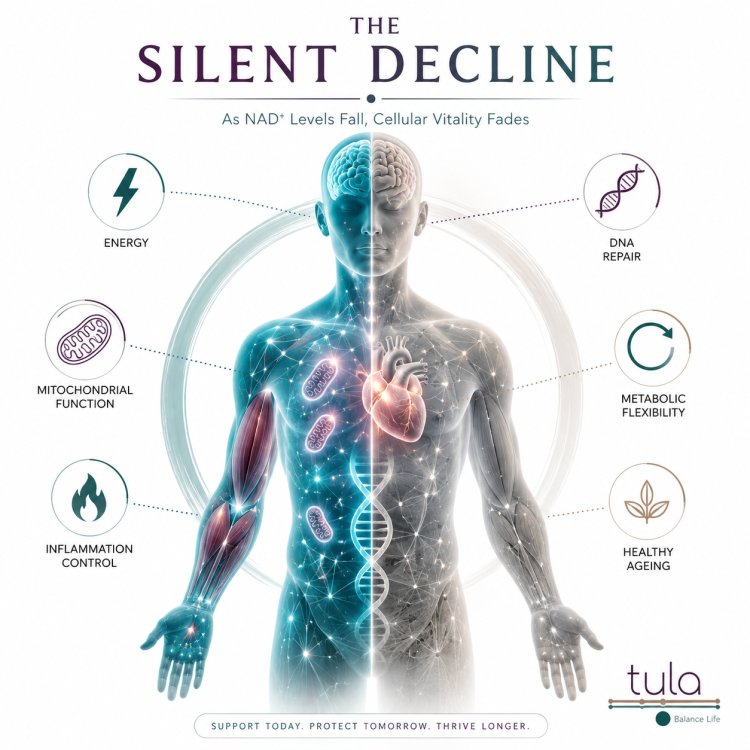
Many of these essential processes depend on NAD⁺. One of its best-known roles is helping convert carbohydrates, fats, and proteins into ATP, the energy molecule that powers every heartbeat, muscle contraction, and nerve signal. But NAD⁺ does much more than help make energy. It also supports proteins involved in cellular repair, metabolic health, inflammation control, and healthy ageing.

Without enough NAD⁺, these systems simply cannot operate at their full potential.


The Molecule You Never Think About

Most people have heard of cholesterol.

Many know about vitamin D.

Some are familiar with magnesium.

Very few have heard of NAD⁺.

Yet every cell depends on it.

Imagine running a city.

Electricity powers homes, hospitals, traffic lights, factories, and communication systems.

You rarely think about electricity—until the power goes out.

NAD⁺ works in a similar way.

As long as your cells have enough of it, countless processes continue quietly in the background.

When levels begin to decline, the effects aren't immediate.

Instead, your body gradually becomes less efficient.


The Decline Starts Earlier Than

Most People Realise

Many people assume ageing begins in their sixties or seventies.

In reality, research suggests that NAD⁺ levels may begin declining as early as our thirties, with the reduction continuing gradually over the following decades. Several lifestyle factors can accelerate this decline, including chronic psychological stress, poor sleep, highly processed diets, excessive alcohol intake, sedentary behaviour, chronic inflammation, environmental toxins, and recurrent illness.

As NAD⁺ availability decreases, the body faces an important decision.

Where should it spend the limited resources that remain?

The answer is simple.

Immediate survival always comes first.

Long-term maintenance gets postponed.


Your Cells Start Working on a Smaller Budget

Think back to our previous blog about The Economy Inside Your Body.

When money becomes scarce, families often postpone home repairs, delay holidays, and cut back on non-essential spending.

Your cells behave in much the same way.

When NAD⁺ levels fall, your body prioritises the processes needed to keep you alive today.

Less urgent tasks—such as optimal repair, resilience, and long-term maintenance—may receive fewer resources.

You may still feel "fine."

But beneath the surface, the budget has changed.


Your Mitochondria Feel It First

The first structures to notice this shortage are the mitochondria—the tiny power stations inside every cell.

These microscopic organelles generate ATP, the energy that powers every movement, heartbeat, thought, and healing process.

Without sufficient NAD⁺, mitochondria become less efficient at producing ATP. The change is usually gradual rather than dramatic. Instead of suddenly feeling exhausted, people often notice subtle shifts:

  • Afternoon fatigue becomes more common
  • Recovery after exercise takes longer
  • Mental focus isn't as sharp
  • Everyday tasks seem to require more effort

Many people simply assume they are "getting older."

But in many cases, their cells may simply be producing energy less efficiently.


Why Energy Declines So Gradually

One of the remarkable features of the human body is its ability to compensate.

When one system becomes less efficient, others often work harder to maintain normal function.

This is why the decline in cellular energy is usually slow and easy to overlook.

You don't wake up one morning feeling old.

Instead, the changes accumulate over years.

A little more fatigue.

A little slower recovery.

A little less resilience.

By the time these changes become obvious, they have often been developing silently for decades.


The First Signs May Not Be What You Expect

Low NAD⁺ doesn't announce itself with a single, obvious symptom.

Instead, people may notice changes such as:

  • Reduced physical stamina
  • Slower exercise recovery
  • Afternoon energy crashes
  • Brain fog
  • Difficulty concentrating
  • Feeling less resilient during stressful periods

These symptoms can have many different causes, but they all remind us of an important principle:

Healthy ageing begins long before disease appears.

Understanding these subtle changes allows us to focus on prevention rather than simply reacting once problems develop.


Your DNA Repair Team Starts Falling Behind

Every single day, your DNA is exposed to damage.

Sunlight.

Pollution.

Stress.

Infections.

Even normal metabolism creates tiny injuries to your genetic material.

Fortunately, your body has an extraordinary repair system working around the clock.

One of the key repair proteins, called PARP, depends heavily on NAD⁺ to function efficiently. As NAD⁺ levels decline, DNA repair becomes less effective, allowing small amounts of damage to accumulate over time.

Think of it like owning a house.

If you repair every small crack as soon as it appears, the house remains strong for decades.

Ignore those cracks year after year, and eventually the structure begins to weaken.

The same principle applies to your cells.

Healthy ageing isn't just about preventing damage.

It's about repairing damage efficiently.


Inflammation Starts Whispering

Instead of Shouting

When most people hear the word inflammation, they think of pain, swelling, or fever.

But inflammation doesn't always announce itself so dramatically.

Sometimes it whispers.

Low-grade chronic inflammation can quietly persist for years without causing obvious symptoms. Reduced NAD⁺ limits the activity of proteins called sirtuins, particularly SIRT1, which normally help regulate inflammatory pathways. As this protective influence weakens, inflammatory signals become easier to activate and harder to switch off.

This persistent "background inflammation" has been associated with many age-related conditions, including metabolic dysfunction, cardiovascular disease, neurodegeneration, and impaired immune function.


Your Brain Notices the Difference

Although your brain makes up only about 2% of your body weight, it uses nearly 20% of your body's energy.

That means even small reductions in cellular energy production can have noticeable effects.

As NAD⁺ declines, mitochondrial function within brain cells may become less efficient, reducing the brain's ability to generate energy. People may begin to experience:

  • Brain fog
  • Reduced concentration
  • Slower information processing
  • Mental fatigue
  • Difficulty adapting to stress

These changes don't happen overnight.

They often develop gradually, making them easy to dismiss as "normal ageing."


Your Metabolism Becomes Less Flexible

A healthy metabolism allows your body to switch efficiently between burning carbohydrates and fats depending on your energy needs.

Lower NAD⁺ levels may reduce this metabolic flexibility, making cells less efficient at extracting energy from nutrients over time. While NAD⁺ alone is not responsible for weight gain or insulin resistance, it plays an important supporting role in maintaining healthy metabolic function.

This is another reminder that metabolism is not determined by a single hormone or nutrient—it depends on the health of the entire cellular system.


Can You Protect Your NAD⁺?

The encouraging news is that many of the factors influencing NAD⁺ metabolism are within your control.

Research suggests that healthy lifestyle habits help support NAD⁺ metabolism, including:

  • Prioritising consistent, restorative sleep
  • Exercising regularly, especially combining aerobic and resistance training
  • Reducing excessive sugar and ultra-processed foods
  • Managing chronic stress through meditation, yoga, or breathing exercises
  • Maintaining a healthy body weight
  • Including foods rich in vitamin B3 (niacin), an important precursor of NAD⁺

Notice something important.

None of these are expensive.

None are quick fixes.

They are the same foundations that support almost every aspect of good health.


What About NAD⁺ Supplements and

IV Therapy?

In recent years, therapies aimed at restoring NAD⁺ levels have attracted significant scientific interest.

NAD⁺ precursors such as nicotinamide riboside (NR) and nicotinamide mononucleotide (NMN), along with intravenous (IV) NAD⁺ therapy, have been shown to increase NAD⁺ availability in the body. Emerging clinical studies suggest potential benefits for cellular energy metabolism, healthy ageing, neurological function, metabolic health, and recovery from physiological stress.

However, these approaches should be viewed as complementary to—not replacements for—a healthy lifestyle.

No supplement can consistently overcome the effects of poor sleep, chronic stress, physical inactivity, and an unhealthy diet.


Dr. Priya's Insight

One of the biggest myths about ageing is that it begins when wrinkles appear.

In reality, ageing begins much earlier—inside our cells.

The gradual decline of NAD⁺ is one example of the hidden biological changes that quietly influence how efficiently our bodies generate energy, repair damage, regulate inflammation, and respond to daily stress.

The encouraging news is that cellular ageing is not entirely beyond our control.

Every night of restorative sleep.

Every nourishing meal.

Every workout.

Every effort to reduce chronic stress.

These are daily investments in the systems that depend on NAD⁺.

At Tula Wellness Hub, we believe healthy ageing isn't about trying to stop time.

It's about giving every cell the support it needs to function at its best for as long as possible.


Frequently Asked Questions

What is NAD⁺?

NAD⁺ (Nicotinamide Adenine Dinucleotide) is a molecule found in every cell that plays an essential role in energy production, DNA repair, cellular metabolism, and healthy ageing.


At what age do NAD⁺ levels begin to decline?

Research discussed in the newsletter suggests NAD⁺ levels may begin declining as early as our thirties, with gradual reductions continuing over subsequent decades.


Can lifestyle affect NAD⁺ levels?

Yes. Sleep, exercise, nutrition, stress management, maintaining a healthy body weight, and adequate vitamin B3 intake all help support healthy NAD⁺ metabolism.


Does NAD⁺ affect brain function?

Healthy NAD⁺ supports efficient energy production within brain cells. Declining levels may contribute to brain fog, reduced concentration, slower processing, and mental fatigue.


Are NR, NMN, and IV NAD⁺ therapy effective?

The newsletter notes that these therapies can increase NAD⁺ availability and have shown promising potential in emerging studies, particularly when combined with healthy lifestyle measures.


Key Takeaways

  • NAD⁺ is essential for cellular energy production, DNA repair, and healthy ageing.
  • NAD⁺ levels gradually decline with age and can be accelerated by chronic stress, poor sleep, processed diets, inactivity, and inflammation.
  • Reduced NAD⁺ affects mitochondria, brain function, metabolism, and cellular repair.
  • Healthy lifestyle habits remain the foundation for supporting NAD⁺ metabolism.
  • Emerging therapies such as NR, NMN, and IV NAD⁺ are promising but work best alongside healthy daily habits.

Healthy Ageing Begins Inside Every Cell

Ageing isn't defined by the number of birthdays you've celebrated.

It's shaped by what happens inside your cells every single day.

By protecting the systems that produce energy, repair damage, and regulate inflammation, you give your body the opportunity to remain healthier for longer.

At Tula Wellness Hub, our Functional and Lifestyle Medicine approach focuses on supporting cellular health through evidence-based nutrition, movement, restorative sleep, stress management, and personalised therapies.

Because healthy ageing doesn't begin when wrinkles appear.

It begins with the health of your cells today.