


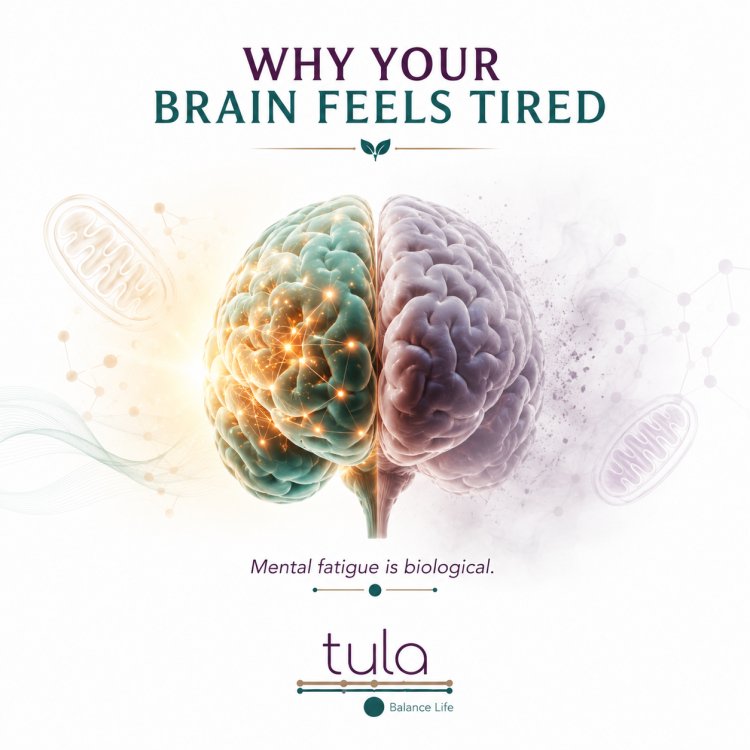
Why Your Brain Feels Tired
The Biology of Mental Fatigue
When Thinking Becomes Metabolically Expensive
Have you ever reached the end of a day feeling completely exhausted—even though you barely moved?
You weren't exercising.
You weren't doing physical labour.
Perhaps you spent most of the day sitting at a desk.
Yet by evening, your brain feels as though it has run a marathon.
You struggle to concentrate.
Simple decisions feel difficult.
You reread the same sentence three times.
You open your phone and forget why.
And eventually you say:
“My brain is tired.”
That feeling is real.
Reading, problem-solving, making decisions, concentrating, remembering information and constantly switching between tasks require coordinated activity across billions of neurons.
Mental fatigue isn't necessarily a lack of motivation.
Sometimes it is your body's way of telling you:
Your brain needs recovery.
Thinking Is Biological Work
We tend to separate mental work from physical work.
If you spend three hours exercising, you expect to feel tired.
But if you spend three hours analysing spreadsheets, answering emails, solving problems or making important decisions, you may wonder:
“Why am I so exhausted? I've been sitting all day.”
Because sitting still doesn't mean your brain is resting.
Every decision.
Every calculation.
Every conversation.
Every memory you retrieve.
Every moment you concentrate.
All of it depends on an extraordinarily complex network of neurons, electrical signals, chemical messengers, oxygen, mitochondria and energy-producing pathways.
Thinking is biological work.
Your Brain Is an Energy-Hungry Organ
Your brain is metabolically active even when you're apparently doing nothing.
Billions of neurons are constantly maintaining electrical gradients across their cell membranes.
Every time a nerve impulse occurs, ions move across these membranes.
Those gradients then need to be restored.
And restoring them requires energy.
That energy comes largely in the form of ATP—the cellular energy currency.
A significant proportion of the brain's energy expenditure isn't simply being used for conscious thought. It is being used to maintain the basic machinery that allows billions of neurons to communicate with one another.
So even while you're sitting quietly at your desk, your brain is anything but quiet.
Does Thinking Simply Use Up Your Glucose?
This is a common misconception.
You feel mentally tired.
You crave something sweet.
So it seems logical to assume:
“My brain must have run out of glucose.”
But mental fatigue is much more complicated.
Under ordinary circumstances, the brain relies primarily on glucose for fuel, although it can adapt to alternative fuels such as ketone bodies during prolonged fasting.
But mental fatigue doesn't simply mean that you've emptied your brain's glucose tank.
The brain has sophisticated mechanisms for maintaining energy availability.
Instead, fatigue is more likely to reflect the overall demands being placed on neural networks and changes in how efficiently the brain is able to continue performing demanding tasks.
This is why another cup of coffee or a sugary snack doesn't necessarily solve the problem.
Sometimes what your brain needs isn't more stimulation.
It needs less demand.
Not All Thinking Costs the Same
Think about driving a familiar route home.
You may barely remember parts of the journey because the task has become highly automatic.
Now compare that with:
-
Learning something completely new
-
Solving a complicated problem
-
Making an important financial decision
-
Writing a detailed report
-
Remembering several pieces of information simultaneously
-
Trying not to become distracted
-
Switching repeatedly between unrelated tasks
These require much more conscious coordination.
Sustained attention, working memory, inhibition, decision-making and complex problem-solving place greater demands on neural networks.
And modern life asks us to do these things continuously.
The Hidden Cost of Multitasking
Imagine a typical working morning.
You're preparing a presentation.
An email arrives.
You stop and answer it.
Your phone vibrates.
You check WhatsApp.
Someone asks you a question.
You return to your presentation.
Then you remember an appointment you need to schedule.
You make the call.
Another notification appears.
Then you try to remember:
“Where was I?”
We often call this multitasking.
But from the brain's perspective, you're repeatedly reconfiguring attention between competing demands.
Each interruption forces your attention to disengage from one task and reorganise around another.
Over several hours, concentration becomes harder.
Mistakes become more likely.
And even relatively simple decisions may begin to feel disproportionately difficult.
You've probably experienced this.
You're staring at the computer.
You know exactly what needs to be done.
The task isn't even particularly difficult.
But somehow you cannot make yourself engage with it.
That can be an expression of mental fatigue.
Why Decision-Making Becomes Harder
Mental fatigue doesn't always feel like sleepiness.
Sometimes it looks like:
“I don't care. You decide.”
What should we eat tonight?
Which email should I answer first?
Should I exercise?
Should I make that phone call?
What should I buy?
What should I cook?
Decisions that would normally take seconds suddenly feel exhausting.
The issue isn't necessarily that you've lost the ability to make decisions.
Your brain may simply have been making too many of them already.
And today, the number of tiny decisions we make has exploded.
Notifications.
Emails.
Messages.
Meetings.
Social media.
Online shopping.
News.
Appointments.
Work decisions.
Family decisions.
Even deciding what deserves our attention has become another decision.
The accumulation of these small cognitive demands creates continuous mental noise.
Worry Is Also Work
This may be one of the most overlooked causes of mental exhaustion.
You don't need to be actively working to keep your brain busy.
You can sit perfectly still while your mind is processing:
What if something goes wrong?
Did I make the right decision?
What will happen tomorrow?
Why hasn't that person replied?
What if I forget something?
Stress activates physiological systems designed to help us respond to challenges.
In the short term, this can actually improve alertness and focus.
But when that “on” signal remains active for too long, recovery becomes more difficult.
Persistent stress can interfere with attention, working memory, emotional regulation and sleep.
Instead of using cognitive resources primarily for what's happening in front of you, part of your processing capacity remains occupied by worry, anticipation and emotional monitoring.
In other words:
Worry is also work.
That's why you can spend an entire day sitting at a desk and still finish it feeling profoundly exhausted.
Your muscles may not have been working particularly hard.
But your brain never really clocked out.
The Mental Fatigue Cycle
And this is where mental fatigue can become self-perpetuating.
You have a cognitively demanding day.
You become mentally exhausted.
Stress makes it difficult to switch off.
You sleep poorly.
The next morning, your attention, working memory and emotional regulation aren't fully restored.
Tasks require more effort.
You become fatigued sooner.
And the cycle begins again.
The newsletter describes it simply:
High cognitive demand → mental fatigue → poor sleep → reduced cognitive efficiency → greater effort required the next day.
The answer isn't always to push harder.
Sometimes the solution is to improve recovery.
Sleep: The Brain's Maintenance Shift
If mental work creates demand, sleep creates an opportunity for recovery.
We often think of sleep as the time when the brain simply switches off.
It doesn't.
Different stages of sleep support memory processing, emotional regulation, synaptic changes and restoration of normal brain function.
When sleep is inadequate, attention, reaction time, working memory and emotional regulation can all suffer.
This explains why a difficult task can feel dramatically harder after a poor night's sleep.
The task hasn't changed.
The brain you're asking to perform it has.
And this can create the cycle we discussed in Part 1:
High cognitive demand → mental fatigue → poor sleep → reduced cognitive efficiency → greater effort the next day.
Recovery isn't something we should wait for until we're completely exhausted.
It needs to be built into the way we live.
Can Food Fix a Tired Brain?
When concentration starts dropping in the afternoon, many of us instinctively reach for something.
Coffee.
Chocolate.
Biscuits.
Something sweet.
But if mental fatigue isn't simply the result of "running out of glucose," repeatedly supplying sugar isn't necessarily the answer.
Stable energy availability depends on much more:
-
Overall dietary quality
-
Hydration
-
Meal composition
-
Metabolic health
-
Adequate micronutrients
Protein supplies amino acids needed for numerous physiological processes.
Healthy fats provide important structural components for cell membranes.
Vitamins and minerals act as cofactors in energy metabolism and neurological processes.
So instead of asking:
"What can I eat right now to give my brain energy?"
A better question may be:
"Am I consistently giving my brain the biological building blocks it needs to function well?"
Your Mitochondria Matter Too
Every thought ultimately depends on energy.
And much of that cellular energy is produced by the mitochondria.
Your brain has a particularly high demand for oxygen because it relies heavily on oxidative metabolism. Oxygen, nutrients and healthy mitochondrial function therefore form part of the biological foundation that allows neurons to do their work.
This is one reason mental fatigue shouldn't always be viewed purely as a psychological experience.
The way you feel mentally is connected to what is happening biologically.
Sleep.
Nutrition.
Oxygen delivery.
Metabolic health.
Stress.
Cellular energy.
They don't operate in isolation.
Movement Is Part of Brain Recovery
When your brain feels tired, exercise may be the last thing you feel like doing.
But mental recovery doesn't necessarily mean lying down.
Movement can provide a valuable change in state.
Instead of spending another hour staring at a screen, stepping outside for a walk or engaging in regular exercise creates a break from continuous cognitive demand.
The newsletter's brain-recovery foundation includes exercise alongside adequate sleep, nourishing food and stress-regulating practices.
Sometimes the most useful break from mental work is physical movement.
Recovery Doesn't Always Require Another Treatment
When we're exhausted, it's tempting to search for something that will make us perform better.
Another coffee.
Another supplement.
Another productivity hack.
Another treatment.
But sometimes the nervous system needs something much simpler:
A change from performance mode to recovery mode.
Yoga and meditation may support stress regulation, attention, sleep and relaxation.
Even a few minutes of slow breathing or mindful movement can help create that shift.
You don't necessarily need an hour-long meditation session.
You may simply need moments during the day when your brain is no longer being asked to solve, decide, remember, respond or perform.
The Modern Problem: Too Much Cognitive Noise
One major reason mental fatigue has become so familiar is that the brain rarely gets genuine downtime.
Think about what happens during a typical "break."
You stop working.
Then you pick up your phone.
WhatsApp.
Instagram.
Email.
News.
YouTube.
A few notifications.
Perhaps a quick online purchase.
Then back to work.
Technically, you took a break.
But did your brain?
The newsletter identifies notifications, emails, meetings, messages, social media, multitasking and constant decisions as small demands that accumulate into continuous cognitive interruptions.
This distinction matters.
Stopping work is not necessarily the same as recovering from work.
Sometimes recovery requires genuine disengagement.
Create Periods of Uninterrupted Focus
There is another side to reducing cognitive noise.
Instead of constantly switching between tasks, create periods where the brain is allowed to do one thing.
Write the report.
Have the conversation.
Read the article.
Finish the presentation.
Then move to the next task.
Creating periods of uninterrupted focus and genuine disengagement can help restore a clearer boundary between work and recovery.
The aim isn't to eliminate every interruption from modern life.
That's unrealistic.
The aim is to stop making interruption your brain's default operating mode.
A Simple Brain-Recovery Routine
Mental resilience isn't about learning to work endlessly.
It's about balancing cognitive demand with recovery.
Start with the foundations.
1. Protect Your Sleep
Don't treat sleep as whatever time remains after everything else is finished.
Make it part of your recovery strategy.
2. Stop Grazing on Information
You don't need to respond to every notification immediately.
Create periods where your attention belongs to one task.
3. Take Real Breaks
A break filled with emails, social media and news may simply replace one form of cognitive demand with another.
Walk.
Stretch.
Look outside.
Breathe.
Or simply sit without consuming more information.
4. Nourish Your Brain Consistently
Prioritise adequate hydration, protein, healthy fats, whole foods and the micronutrients required for normal energy metabolism.
5. Move Your Body
Regular exercise belongs in a brain-recovery routine, not just a weight-loss programme.
6. Create a Recovery State
Yoga, meditation, mindful movement or a few minutes of slow breathing can help create deliberate periods of relaxation.
7. Reduce Unnecessary Decisions
Not every decision deserves your best cognitive energy.
Simplify routine choices where possible and protect your attention for the things that actually matter.
Where Do IV Nutrition, HBOT and Red-Light Therapy Fit?
These therapies need to be placed in the right context.
They are not substitutes for sleep, nutrition, exercise, stress regulation or addressing the underlying cause of fatigue.
For individuals with clinically identified nutritional deficiencies or increased nutritional requirements, IV nutrition may be used as supportive therapy under appropriate medical supervision. Correcting relevant deficiencies can provide biological building blocks needed for normal energy metabolism and neurological function.
Hyperbaric oxygen therapy (HBOT) increases the amount of oxygen dissolved in plasma and may support tissue repair and recovery in appropriate clinical settings. For general mental fatigue, however, it should complement—not replace—the fundamentals.
Photobiomodulation, or red and near-infrared light therapy, is being studied for its effects on mitochondrial function, cellular signalling and oxidative stress, making it a potential supportive approach to cognitive and cellular wellness.
The sequence matters:
Build the foundation first.
Then consider supportive therapies when they are appropriate for the individual.
Dr. Priya's Insight
Mental fatigue is not simply about how many hours you worked.
It is also about how many hours your brain was never allowed to stop working.
Thinking is biological work.
Every decision, memory, calculation, conversation and moment of concentration depends on neurons, electrical signals, chemical messengers, mitochondria, oxygen and energy-producing pathways.
But modern life asks the brain to remain continuously available.
Work ends—but WhatsApp begins.
A meeting finishes—but notifications arrive.
We sit down to rest—but start scrolling.
Even when nothing is happening, we may continue worrying about tomorrow.
The brain was never designed to remain continuously stimulated from morning until night.
Sometimes the most productive thing we can do isn't push harder.
It is to create the conditions for the brain to recover.
A healthy mind doesn't work endlessly.
It knows when to focus, when to pause and when to restore.
Frequently Asked Questions
Why does thinking make me feel physically tired?
Mental work requires coordinated neural activity and cellular energy. Sustained attention, working memory, decision-making and repeated task-switching can increase cognitive demand and contribute to mental fatigue.
Does mental fatigue mean my brain has run out of glucose?
No. The brain has sophisticated mechanisms for maintaining energy availability. Mental fatigue is more likely to reflect the demands placed on neural networks and changes in how efficiently the brain continues performing those tasks.
Can stress cause mental fatigue?
Yes. Persistent stress can interfere with attention, working memory, emotional regulation and sleep. Worry and emotional monitoring can themselves occupy cognitive resources.
Why does poor sleep make concentration harder?
Sleep supports memory processing, emotional regulation, synaptic changes and restoration of normal brain function. Inadequate sleep can impair attention, reaction time and working memory.
Can nutrition help mental fatigue?
Good nutrition supports normal brain and cellular energy metabolism. Hydration, meal composition, dietary quality and adequate micronutrients all matter, while clinically identified deficiencies may require targeted correction.
Are HBOT, IV therapy or red-light therapy treatments for mental fatigue?
The newsletter presents them as potential supportive approaches in appropriately selected individuals, not as replacements for sleep, stress management, nutrition or addressing underlying causes.
Key Takeaways
-
Thinking is biological work.
-
Mental fatigue isn't simply a lack of motivation.
-
Your brain requires substantial cellular energy even while you're sitting still.
-
Multitasking and constant task-switching create additional cognitive demands.
-
Worry is also work.
-
Sleep is one of the brain's most important opportunities for recovery.
-
Nutrition, hydration, movement and stress regulation provide the foundation for brain health.
-
A phone-filled "break" may not actually be a cognitive break.
-
IV nutrition, HBOT and red-light therapy may have supportive roles for appropriately selected individuals, but they don't replace the fundamentals.
-
Mental resilience isn't about working longer. It's about balancing demand with recovery.
Don't Wait Until Your Brain Is Exhausted
We have become very good at recognising physical fatigue.
When our muscles hurt, we rest.
When our body is exhausted, we slow down.
But when our brain becomes tired, our instinct is often the opposite.
We push harder.
Drink another coffee.
Open another tab.
Answer another message.
Mental fatigue deserves the same respect as physical fatigue.
Your brain doesn't need to perform every minute you're awake.
It needs periods of focus.
Periods of movement.
Periods of nourishment.
Periods of sleep.
And periods when nothing is being demanded of it at all.
At Tula Wellness Hub, our Functional and Lifestyle Medicine approach looks at the factors that influence energy and cognitive wellbeing—from nutrition, sleep and stress to movement, metabolic health and appropriately selected supportive therapies.
Because sometimes the answer to a tired brain isn't another way to make it work harder.
It's finally giving it permission to recover.









Dr. Priya Vasudevan M.D, AB. Dip ABLM