


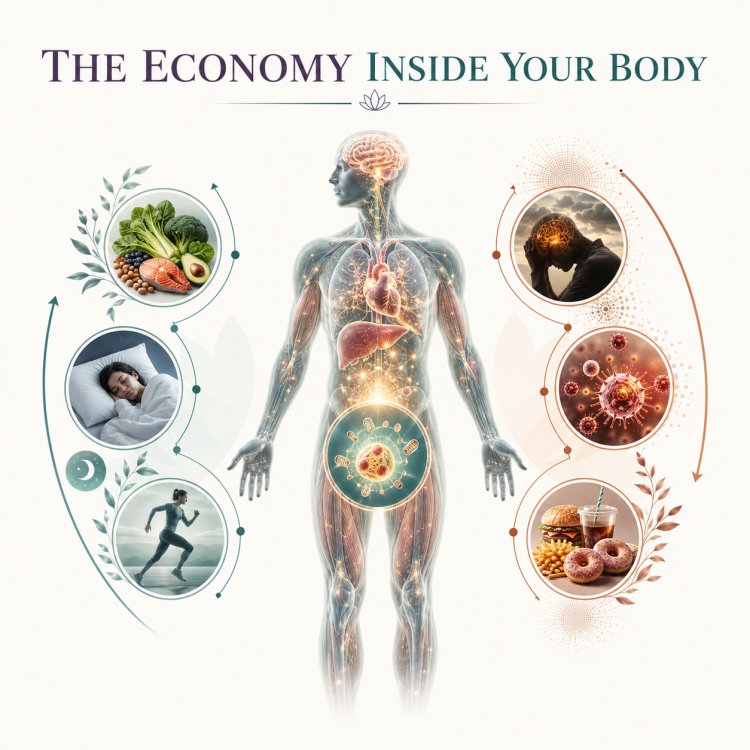
The Economy Inside Your Body:
Are You Building Health or Biological Debt?
Every cell has a budget. Every organ has expenses. Your lifestyle influences whether your body builds health or accumulates biological debt.
When we hear the word “economy,” we usually think about income, expenses, savings, investments and debt. Surprisingly, your body can be understood in much the same way.
Every second, trillions of cells use nutrients, oxygen and energy to keep you alive. Every meal you eat, every hour you sleep, every workout you complete and every stressful moment affects this internal balance sheet.
A healthy body is not simply one that receives enough calories. It is one that has the resources and metabolic flexibility to produce energy, repair damage, regulate hormones and respond appropriately to stress.
1. ATP Is the Currency of Cellular Life
Just as money allows an economy to function, adenosine triphosphate—or ATP—provides usable energy for your cells.
ATP is required for:
- Muscle contraction
- Nerve signalling
- Heart function
- Transport across cell membranes
- Protein synthesis
- Tissue repair
- Numerous metabolic reactions
Most ATP is produced through cellular respiration, with mitochondria playing a central role.
The body does not store large reserves of ATP. It must continually produce and recycle it according to demand.
This is why mitochondrial function matters. When energy production cannot keep pace with the body’s needs, fatigue, reduced exercise tolerance and slower recovery may follow.
2. Your Organs Have Different Energy Demands
Imagine your organs as departments within a large organisation.
- The brain manages communication, memory and decision-making.
- The heart maintains continuous circulation.
- The liver processes nutrients and supports metabolism and detoxification.
- The kidneys regulate fluid balance and remove waste.
- The immune system protects the body and coordinates repair.
Each department requires a dependable supply of energy and nutrients.
During illness, severe calorie restriction, prolonged sleep deprivation or chronic stress, the body may prioritise immediate survival over less urgent functions.
Hair growth, reproductive function, muscle building and optimal digestion may receive fewer resources.
This does not necessarily mean that the body is failing. It may be adapting to what it perceives as limited resources.
3. Chronic Inflammation Is a Recurring Expense
Inflammation is not inherently harmful. Short-term inflammation is an essential part of the body’s response to infection, injury and tissue damage.
The problem begins when inflammation does not resolve appropriately.
Chronic inflammation continually draws upon:
- Energy
- Amino acids
- Antioxidants
- Vitamins and minerals
- Immune-system resources
Over time, this recurring biological expense may interfere with recovery and contribute to metabolic dysfunction, cardiovascular disease, insulin resistance and accelerated ageing.
Poor diet, inadequate sleep, chronic stress, smoking, excess visceral fat and unresolved health conditions can all contribute to persistent inflammation.
To understand these hidden triggers better, read our guide on what causes inflammation in the body.
4. Food Is More Than Calories—It Is Biological Income
Food is the body’s daily source of raw materials.
Different nutrients make different contributions:
- Protein provides amino acids for muscles, enzymes, hormones and immune cells.
- Healthy fats support cell membranes, the brain and hormone production.
- Complex carbohydrates can provide accessible energy and fibre.
- Vitamins and minerals support thousands of enzymatic reactions.
- Water helps transport nutrients, regulate temperature and remove waste.
A highly processed diet may provide excess calories while still lacking adequate protein, fibre and micronutrients.
In other words, the body may receive plenty of money but very little real purchasing power.
This is sometimes described as “hidden hunger”—adequate calorie intake accompanied by poor nutrient density.
Whole foods, colourful vegetables, quality protein, healthy fats, nuts, seeds and minimally processed carbohydrates give the body a more valuable form of biological income.
Food is therefore not simply fuel. It provides information and raw materials that influence inflammation, metabolism, hormones, the gut microbiome and cellular repair.
You can explore this connection further in Food as Science in Medicine: Why Healing Begins on the Plate.
5. Sleep Is a Nightly Reinvestment Strategy
Sleep is not an unproductive period. It is when the body redirects resources towards maintenance, regulation and recovery.
During healthy sleep, the body supports:
- Tissue repair and protein synthesis
- Immune regulation
- Memory consolidation
- Hormonal and metabolic regulation
- Nervous-system recovery
- Restoration of physical and mental energy
Consistently poor sleep affects much more than morning alertness. It can influence appetite, blood sugar regulation, stress hormones, immune function and inflammation.
Think of sleep as the time when your body reviews the accounts, performs essential maintenance and prepares for the next day.








Dr. Priya Vasudevan M.D, AB. Dip ABLM