


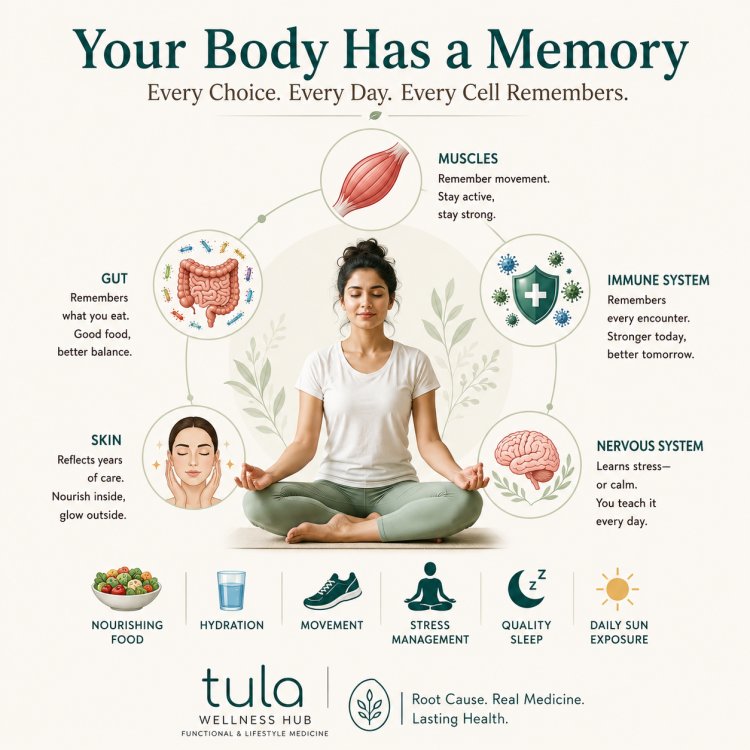
When we hear the word memory, we naturally think of the brain. We remember birthdays, recognize familiar faces, recall childhood experiences, and learn new skills. But modern science has revealed something remarkable: memory isn't limited to the brain.
Your body has its own remarkable way of "remembering."
Every nutritious meal you eat, every hour of quality sleep, every workout you complete, every stressful day you endure, and every illness you recover from leaves a biological imprint on your body. These experiences shape how your cells, muscles, immune system, gut, and even your skin respond in the future.
This doesn't mean your organs literally think or store memories like your brain does. Instead, they adapt through biological changes that influence how they function over time. Scientists refer to this as biological memory or cellular adaptation.
The exciting part is that these adaptations work both ways.
Healthy habits create positive biological memories that make your body stronger and more resilient. Unhealthy habits can also leave lasting effects—but the encouraging news is that many of these changes can improve when we consistently make healthier choices.
Understanding how your body "remembers" helps us appreciate one important truth:
Every healthy decision matters, even when you don't see immediate results.
Your Muscles Remember Movement
Have you ever noticed how someone who exercised regularly years ago often regains strength much faster than someone who has never exercised before?
This phenomenon is commonly known as muscle memory.
For many years, scientists believed muscle memory existed only in the brain because repeated movements became easier with practice. We now know that our muscles themselves undergo lasting biological changes during exercise.
When you perform resistance training or regular physical activity, muscle fibers adapt by becoming stronger and more efficient. Research suggests that muscle cells retain certain structural changes even after periods of inactivity, making it easier to rebuild strength when exercise resumes.
This is incredibly encouraging.
Taking a break from exercise due to illness, work, travel, or family responsibilities does not erase all of your previous effort.
Your muscles have already learned.
They simply need a reminder.
This is why consistency matters far more than perfection.
Missing two weeks at the gym does not undo two years of healthy habits.
Every walk, every yoga session, every stretch, every resistance exercise, and every climb up the stairs teaches your muscles to become stronger, more efficient, and more resilient.
Your Immune System Learns From Every Encounter
One of the most fascinating examples of body memory is found within your immune system.
Every time your immune system encounters a virus, bacterium, or vaccine, it learns from that experience.
Specialized immune cells store information about previous invaders, allowing the body to respond much faster if the same threat appears again.
This remarkable process is known as immune memory, and it forms the foundation of long-term immunity.
Without immune memory, every infection would feel like the first one.
But immune memory extends beyond infections.
Your immune system also responds to the signals it receives every day from your lifestyle.
Quality sleep, regular physical activity, nutritious food, healthy gut bacteria, and stress management all help create an environment that supports balanced immune function.
On the other hand, chronic sleep deprivation, ongoing stress, poor nutrition, smoking, and inactivity may repeatedly signal the immune system to remain in a state of chronic inflammation.
In many ways, your immune system is continuously "learning" from how you live.
Your Gut Remembers What You Eat
Inside your digestive tract live trillions of microorganisms collectively known as the gut microbiome.
These bacteria, fungi, and other microbes play important roles in:
-
Digestion
-
Vitamin production
-
Immune regulation
-
Hormone metabolism
-
Mental wellbeing
-
Inflammation
-
Metabolic health
One of the most remarkable features of the gut microbiome is its ability to adapt.
Every meal you eat influences which microbes thrive and which decline.
A diet rich in vegetables, fruits, legumes, whole grains, nuts, seeds, and other fibre-rich foods encourages beneficial bacteria to flourish.
These microbes produce compounds called short-chain fatty acids, which help nourish the intestinal lining, regulate inflammation, and support overall health.
Conversely, diets high in ultra-processed foods, excessive sugar, and low dietary variety may reduce microbial diversity and encourage less beneficial bacterial populations.
Over weeks, months, and years, your gut begins to reflect your daily eating patterns.
In a sense, your gut "remembers" your diet because the microbial community living within it changes based on the choices you repeatedly make.
This also explains why improving gut health rarely happens overnight.
Just as unhealthy habits gradually shape the microbiome, healthier eating patterns allow beneficial microbes to grow and restore balance over time.
Every meal becomes an opportunity to influence the ecosystem inside your body.
Your Skin Tells the Story of Your Lifestyle
Although your skin continuously renews itself, it also reflects years of accumulated experiences.
Think about everything your skin encounters throughout life:
-
Sunlight
-
Pollution
-
Smoking
-
Dehydration
-
Stress
-
Sleep deprivation
-
Poor nutrition
-
Environmental toxins
These factors gradually influence skin structure, collagen production, hydration, elasticity, pigmentation, and overall appearance.
Likewise, healthy habits create positive changes.
Consistent hydration, balanced nutrition, regular physical activity, adequate sleep, stress reduction, and sun protection all support healthier skin over time.
Your skin may not remember specific events, but it certainly reflects the cumulative effects of your lifestyle.
This is why healthy skin isn't simply about expensive creams or cosmetic procedures.
Beautiful skin often begins with healthy cells, good circulation, balanced nutrition, restful sleep, and a healthy gut.
In many ways, your skin quietly tells the story of how consistently you've cared for your body.
Your Nervous System Remembers Stress
Have you ever noticed that during stressful periods your body seems to react automatically?
Your shoulders tense.
Your breathing becomes shallow.
Your heart rate increases.
Your digestion slows.
These responses are part of the body's natural survival system.
However, when stress becomes chronic, the nervous system can become conditioned to remain in a heightened state of alertness—even when no immediate danger exists.
This is sometimes referred to as a "learned stress response."
The encouraging news is that just as the nervous system can learn stress, it can also learn calm.
Practices such as deep breathing, meditation, yoga, prayer, mindfulness, spending time in nature, and meaningful social connection help retrain the nervous system toward resilience and recovery.
Just as repeated stress leaves a biological imprint, repeated moments of calm create new, healthier patterns.
Your Cells Remember More Than You Think
One of the most exciting discoveries in modern medicine is that our cells are constantly adapting to the environment around them.
Scientists call this cellular adaptation, and much of it is influenced by a field known as epigenetics.
Your DNA provides the blueprint for your body, but your lifestyle helps determine which parts of that blueprint are switched on or off. In other words, while you cannot change the genes you inherit, you can influence how many of those genes are expressed.
Nutrition, physical activity, sleep, chronic stress, environmental toxins, smoking, alcohol, and even meaningful social connections all send signals to your cells.
Over time, repeated exposure to these signals creates biological adaptations that affect inflammation, metabolism, immune function, energy production, and healthy aging.
This is why your daily choices matter so much.
Every healthy habit is like casting a vote for the future version of yourself.
Small Choices Create Lasting Change
Many people believe that improving health requires dramatic changes.
"I need to completely change my diet."
"I need to spend two hours at the gym."
"I need to become perfect."
The truth is far more encouraging.
The body responds remarkably well to small actions performed consistently.
Consider these simple choices:
-
Walking for 20 minutes after dinner.
-
Choosing water instead of a sugary drink.
-
Sleeping 30 minutes earlier.
-
Adding one serving of vegetables to your lunch.
-
Practicing five minutes of deep breathing.
-
Standing up every hour during work.
-
Spending ten minutes in morning sunlight.
Individually, these actions may seem insignificant.
But your body notices every single one.
Just as repeated unhealthy habits gradually increase disease risk, repeated healthy habits gradually improve resilience.
Health is rarely transformed by one extraordinary decision.
It is built through thousands of ordinary decisions repeated over time.
The Power of Consistency
People often become discouraged because they expect immediate results.
They eat healthy for three days and wonder why they don't feel different.
They exercise for one week and expect dramatic changes.
But biology doesn't work that way.
Think of your body as a savings account.
Every healthy meal is a deposit.
Every workout is a deposit.
Every good night's sleep is a deposit.
Every mindful breath is a deposit.
Over weeks, months, and years, these deposits accumulate.
Eventually, your body begins paying you back with:
-
More energy
-
Better mobility
-
Improved metabolic health
-
Stronger immunity
-
Better sleep
-
Greater resilience
-
Healthier aging
Your body is always paying attention.
It remembers consistency—not perfection.
Can the Body "Forget" Unhealthy Habits?
This is one of the most hopeful messages in Lifestyle Medicine.
While certain changes, such as significant sun damage or some chronic diseases, may not be completely reversible, many biological systems remain remarkably adaptable throughout life.
Research shows that improvements in lifestyle can positively influence:
-
Blood sugar regulation
-
Blood pressure
-
Cholesterol levels
-
Muscle strength
-
Bone health
-
Cardiovascular fitness
-
Gut microbiome diversity
-
Sleep quality
-
Mental wellbeing
-
Inflammatory markers
Even people who begin making healthier choices later in life often experience meaningful improvements.
The body has an incredible capacity to heal, repair, and adapt when given the right environment.
It is never too late to begin creating healthier biological memories.
Dr. Priya's Insight
One of the most common questions I hear in clinic is:
"Doctor, have I waited too long?"
My answer is almost always the same.
Your body is adapting every single day.
It doesn't only remember years of unhealthy habits—it also remembers every positive change you begin making today.
When you nourish your gut, your microbiome changes.
When you strength train, your muscles adapt.
When you improve your sleep, your hormones begin to rebalance.
When you manage stress, your nervous system learns safety instead of survival.
Healing doesn't happen because of one perfect meal, one supplement, or one workout.
It happens because your body responds to repeated signals that tell it:
"This is a healthier environment."
At Tula Wellness Hub, our goal isn't simply to treat symptoms.
Our goal is to help create an internal environment where your body can do what it was designed to do—adapt, repair, and thrive.
Frequently Asked Questions
What is muscle memory?
Muscle memory refers to the body's ability to regain strength and movement more quickly after previous training because muscle cells undergo lasting biological adaptations.
Can the immune system remember infections?
Yes. Immune cells store information about previous infections and vaccinations, allowing the body to respond faster when exposed again. This process is called immune memory.
Does the gut really "remember" what we eat?
In a way, yes. The gut microbiome changes based on long-term dietary patterns. Repeated healthy eating encourages beneficial microbes, while poor dietary habits can reduce microbial diversity.
What is epigenetics?
Epigenetics is the study of how lifestyle and environmental factors influence the way genes are expressed without changing the DNA sequence itself.
Is it ever too late to improve my health?
No. Research consistently shows that healthier lifestyle habits can improve many aspects of health at almost any age, including muscle strength, metabolic health, cardiovascular fitness, and overall wellbeing.
Why don't healthy habits show results immediately?
Many biological changes occur gradually. Your body responds to repeated healthy behaviors over weeks, months, and years. Consistency is far more important than perfection.
Key Takeaways
-
Your body remembers much more than your brain alone.
-
Muscles adapt to exercise and regain strength more efficiently after previous training.
-
The immune system develops memory that helps protect against future infections.
-
The gut microbiome reflects your long-term eating habits.
-
Your skin tells the story of years of lifestyle choices.
-
The nervous system can learn both chronic stress and calm.
-
Your cells constantly respond to your environment through biological adaptation.
-
Small healthy choices repeated consistently have a profound impact on long-term health.
Every Healthy Choice Leaves a Lasting Impression
Your brain is not the only part of you that remembers.
Your muscles remember movement.
Your immune system remembers previous challenges.
Your gut remembers how you nourish it.
Your skin reflects years of care.
Your nervous system remembers stress—or calm.
Your cells continuously adapt to the messages you send through your daily habits.
This is one of the most empowering ideas in modern medicine.
You don't need to be perfect.
You simply need to give your body the right signals, consistently.
Every nourishing meal, every walk, every workout, every good night's sleep, every mindful breath, and every act of self-care becomes part of your body's living memory.
And those memories quietly shape your future health.
Begin Building Better Biological Memories Today
At Tula Wellness Hub, we believe lasting health isn't created through quick fixes—it is built through sustainable lifestyle changes that support your body's natural ability to adapt, heal, and thrive.
Whether you're looking to improve your energy, gut health, immunity, metabolic health, or overall wellbeing, our Functional and Lifestyle Medicine approach helps identify the root causes and create a personalized roadmap toward long-term wellness.
Your body is always listening. Make today a memory worth keeping.







Dr. Priya Vasudevan M.D, AB. Dip ABLM