


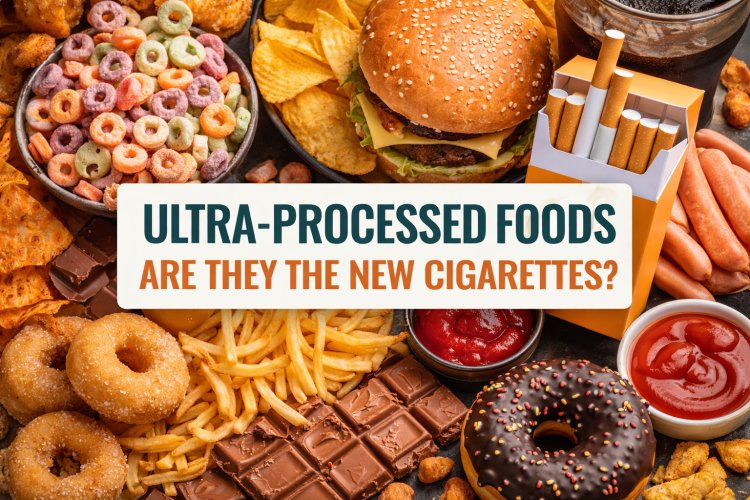
Ultra-Processed Foods in India: Are They the New Cigarettes?
What the Rising Global Debate Means for Your Metabolic Health
If you’ve been feeling like everyone is suddenly talking about ultra-processed foods (UPFs) — you’re not imagining it.
Across the globe, public health experts are debating whether ultra-processed foods should be regulated more like cigarettes than everyday groceries. That’s a major shift. The conversation is no longer just about personal willpower — it’s about food engineering, addiction-like eating behaviors, and industry-driven design.
And here in India, the discussion is getting louder too.
Recent reports suggest India’s Economic Survey has flagged rising ultra-processed food consumption and is exploring policy measures such as advertising restrictions and stronger labeling regulations.
So what does this mean for you and your family?
Let’s break it down — clearly, practically, and without fear-mongering.
What Are Ultra-Processed Foods (UPFs)?
Most people assume UPF simply means “junk food.”
But scientifically, it’s more specific.
According to the NOVA classification system used in research, ultra-processed foods are:
-
Industrial formulations
-
Made largely from substances extracted or modified from foods (refined oils, starches, protein isolates)
-
Combined with additives to create hyper-palatable, shelf-stable products
A Simple Rule of Thumb:
If the ingredient list reads like a chemistry paragraph and contains substances you wouldn’t use in your home kitchen — it’s likely ultra-processed.
Common Ultra-Processed Foods in the Indian Context:
-
Packaged chips, namkeen, biscuits
-
Sugary beverages (including many “health drinks”)
-
Instant noodles and ready-to-eat meals
-
Flavored yogurts and desserts
-
Processed meats
-
“Protein” bars with long ingredient lists
Important nuance:
Not all processed food is bad.
Curd, paneer, tofu, frozen vegetables, canned beans — these are processed, but not ultra-processed. The concern is about industrial formulation patterns designed for overconsumption.
Why Is This Trending Right Now?
There are three major drivers.
1. A Global Push for Regulation
A recent high-profile discussion compared ultra-processed foods to tobacco — arguing that industry design, aggressive marketing, and addiction-like consumption patterns require regulatory intervention.
Whether or not you agree with the comparison, it has brought massive attention to the issue.
2. India’s Growing Concern
India is seeing rising rates of:
-
Obesity
-
Type 2 diabetes
-
Fatty liver disease
-
PCOS
-
Childhood metabolic dysfunction
Public discourse now includes:
-
Restricting food advertisements to children
-
Stronger front-of-pack labeling
-
Tax measures on unhealthy food products
This signals a shift from “individual choice” to “environmental responsibility.”
3. The GLP-1 Medication Era
The rise of medications like semaglutide and tirzepatide (GLP-1 receptor agonists) has changed appetite biology.
Many patients on these medications report:
-
Reduced cravings
-
Less interest in hyper-palatable foods
-
Lower consumption of packaged snacks
This biological shift is forcing the food industry to pay attention.
In simple terms:
Human biology is colliding with food engineering.
What Does the Science Say About Ultra-Processed Foods?
There are two important layers to understand.
Layer 1: Strong Associations
Large population studies consistently link high UPF consumption with:
-
Weight gain
-
Metabolic syndrome
-
Type 2 diabetes
-
Cardiovascular disease
-
Increased inflammatory markers
This doesn’t mean every UPF harms every individual. But across populations, the signal is consistent.
Layer 2: Plausible Mechanisms
It’s not just about calories.
Ultra-processed foods are engineered for:
-
Hyper-palatability (“can’t stop at one” effect)
-
Low satiety density (easy to overeat)
-
Rapid eating speed (liquids and soft foods bypass fullness cues)
-
Optimized texture and flavor layering
-
Aggressive marketing — especially to children
This shifts the discussion from “discipline” to “design.”
A Practical 10-Minute Ultra-Processed Food Audit
You don’t need to eliminate everything.
Start with the 20% that causes 80% of the problem.
Step 1: Identify Your Top 3 UPF Exposures
For most urban Indian families, it’s one of these:
-
Packaged snacks (chips, biscuits, namkeen)
-
Sugary beverages
-
Instant or convenience meals
Step 2: Follow the “Same Convenience Rule”
Replace — don’t restrict.
If you buy chips → keep:
-
Roasted chana
-
Peanuts
-
Makhana
-
Fruit + curd
-
Homemade popcorn
If you drink sweet beverages → keep:
-
Buttermilk
-
Lemon water
-
Unsweetened iced tea
-
Soda + lime + salt
If dinner becomes instant food → keep:
-
Eggs + sautéed vegetables
-
Dal + frozen vegetables + ghee
-
Curd rice + cucumber + protein
-
Quick paneer or tofu bhurji
Same convenience. Different outcome.
Step 3: Use the Ingredient List Speed Test
If you cannot pronounce multiple ingredients and the label reads like a laboratory manual — make it an occasional food, not a daily one.
Not moral.
Not guilt-driven.
Just strategy.
Step 4: Protect Children Through Environment, Not Lectures
What’s at eye level becomes habit.
Put daily snacks at eye level.
Put “sometimes snacks” on the top shelf.
This works better than 100 lectures.
Dr. Priya’s Insight from Tula Wellness Hub
Here in Coimbatore, I’m noticing something interesting.
Many patients are:
-
Walking daily
-
Eating early dinners
-
Switching to millets
-
Taking supplements
And yet, they struggle with:
-
Stubborn weight
-
Fatty liver
-
PCOS patterns
-
Mood swings
-
Sugar cravings
-
Rising fasting glucose
Very often, the missing link isn’t motivation.
It’s hidden ultra-processing in daily life.
The “tea-time biscuit” that became daily.
The “healthy cereal” that behaves like dessert.
The “protein bar” that’s essentially candy with a fitness label.
The “kids’ snack” that adults quietly finish.
My approach at Tula is never “stop everything.”
It is:
-
Stabilize blood sugar first (protein + fiber + mineral support)
-
Reduce the top 2–3 UPF triggers
-
Build a sustainable system you can repeat for 6 months — not 6 days
Metabolic health is built through awareness and consistency — not fear or perfection.
Final Thoughts: The Future of Food Is Awareness
Ultra-processed foods are not evil.
But they are engineered.
When systems change, we adapt intelligently — not fearfully.
At Tula Wellness Hub, we help families create structured, realistic food systems that align with Indian culture, busy schedules, and long-term metabolic health.
If you’d like a personalized food environment audit, we’d love to support you.
Ready to Reset Your Food Environment?
???? Tula Wellness Hub, Coimbatore
???? +91 70300 70400
???? www.tulahealth.in
Book your metabolic consultation and start with clarity — not confusion.








Dr. Priya Vasudevan M.D, AB. Dip ABLM