


Dopamine vs. Serotonin: Why You're Always Chasing Happiness But Never Feeling Satisfied
Have you ever found yourself constantly checking your phone, scrolling social media, craving the next achievement, or feeling excited about buying something—only for the excitement to disappear almost immediately?
Or perhaps you've reached a long-awaited goal, only to find yourself asking, "What's next?"
Many people believe they simply need more dopamine or more serotonin to be happy.
But the truth is far more interesting.
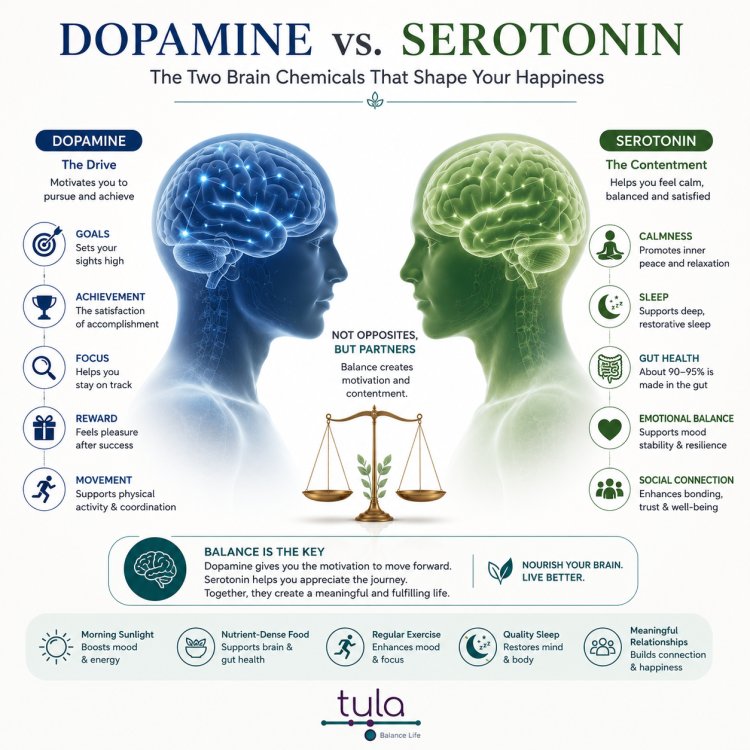
These two brain chemicals are not competing against each other. They work together, each playing a completely different role in shaping your thoughts, emotions, motivation, relationships, and overall well-being.
Think of dopamine as the force that gets you moving.
Think of serotonin as the feeling that tells you the journey was worthwhile.
True happiness isn't created by one or the other.
It's created by the balance between both.
Understanding this balance can change the way you think about productivity, mental health, stress, and even your daily habits.
Meet Your Brain's Chemical Messengers
Your brain contains nearly 86 billion nerve cells.
These cells communicate with one another using tiny chemical messengers called neurotransmitters.
Every emotion you experience...
Every decision you make...
Every memory you form...
Every movement you perform...
Depends on these microscopic molecules carrying messages from one nerve cell to another.
Among dozens of neurotransmitters, dopamine and serotonin are two of the most influential because they affect nearly every aspect of daily life—from motivation and mood to digestion, learning, sleep, and social connection.
Although they are often described as the "happy chemicals," they create happiness in very different ways.
Dopamine: The Brain's Motivation System
Dopamine is often called the motivation molecule.
But that's actually more accurate than calling it the "pleasure chemical."
Dopamine doesn't simply make you feel good.
Instead, it creates anticipation.
It makes you want to pursue something valuable.
Imagine:
-
Training for a marathon.
-
Preparing for an important interview.
-
Starting a new business.
-
Planning a holiday.
-
Learning a new skill.
That excitement...
That anticipation...
That drive to keep moving forward...
Much of it is influenced by dopamine.
Why Our Ancestors Needed Dopamine
Thousands of years ago, dopamine helped humans survive.
It encouraged behaviours such as:
-
Searching for food
-
Building shelter
-
Exploring new environments
-
Learning useful skills
-
Forming relationships
Without motivation, survival would have been impossible.
Our brains rewarded behaviours that improved survival.
Today, however, the same ancient system is responding to very different rewards.
Dopamine in the Modern World
Your brain doesn't always distinguish between meaningful rewards and artificial ones.
The same dopamine system can be activated by:
-
Social media notifications
-
Online shopping
-
Junk food
-
Video games
-
Endless scrolling
-
Gambling
-
Constant phone checking
Every notification.
Every "like."
Every short video.
Every surprise reward.
Produces a small burst of dopamine.
The problem isn't dopamine itself.
The problem is constant stimulation.
When the brain receives quick rewards all day long, everyday activities may begin to feel less interesting.
Reading a book.
Having a conversation.
Cooking.
Going for a walk.
These slower activities cannot compete with endless digital stimulation.
Over time, many people begin craving novelty rather than enjoying ordinary life.
The Dopamine Trap
Imagine eating your favourite dessert every single day.
Eventually, it stops feeling special.
Your brain adapts.
The same thing happens with dopamine.
The more frequently we chase instant rewards...
The less satisfying they become.
This helps explain why many people experience:
-
Constant phone checking
-
Difficulty concentrating
-
Reduced motivation
-
Procrastination
-
Boredom
-
Burnout
Ironically, the harder we chase excitement, the harder it becomes to feel satisfied.
Serotonin: The Chemistry of Contentment
If dopamine helps us pursue happiness, serotonin helps us experience it.
Rather than excitement...
Serotonin creates:
-
Calmness
-
Emotional stability
-
Confidence
-
Inner peace
-
Patience
-
A sense of belonging
-
Long-term well-being
Think of climbing a mountain.
Dopamine is the excitement that keeps you climbing.
Serotonin is sitting quietly at the summit, appreciating the view.
One asks,
"What's next?"
The other says,
"This is enough."
Healthy emotional well-being requires both.
Serotonin Does More Than Influence Mood
Most people associate serotonin with happiness.
But its responsibilities extend far beyond emotions.
Healthy serotonin signalling supports:
-
Stable mood
-
Better sleep
-
Appetite regulation
-
Emotional resilience
-
Social confidence
-
Stress tolerance
-
Healthy digestion
It quietly helps create a feeling of safety and stability that allows us to enjoy life rather than constantly chasing the next reward.
Your Gut Makes Most of Your Serotonin
One of the most surprising facts about serotonin is that around 90–95% of the body's serotonin is produced in the gut, where it helps regulate intestinal movement and digestive function.
Although this gut-produced serotonin does not cross into the brain, a healthy gut still plays an important role in the body's overall serotonin system through nutrition, immune function, and the gut–brain connection.
This is one reason digestive health and mental well-being are so closely linked.
It also explains why Functional Medicine pays so much attention to the gut when addressing chronic stress, mood changes, and overall health.
They Aren't Opposites—They're Partners
One of the biggest misconceptions on social media is that dopamine and serotonin are competing brain chemicals.
They aren't.
In reality, they work together to create a healthy, balanced life.
Think of driving a car.
Dopamine is the accelerator—it gives you the drive to move forward, pursue goals, and seek new experiences.
Serotonin is the steering wheel—it helps you remain emotionally balanced, patient, and satisfied with the journey.
Without dopamine, you may struggle to take action.
Without serotonin, you may achieve success but never feel content.
True well-being comes from having enough motivation to grow while also having enough contentment to appreciate where you are.
Why Balance Matters More Than Boosting One Chemical
Many advertisements promise to "boost dopamine" or "increase serotonin."
But the brain doesn't work that way.
It functions as an incredibly complex network where neurotransmitters constantly influence one another.
Sleep.
Nutrition.
Exercise.
Hormones.
Gut health.
Inflammation.
Stress.
Social relationships.
All shape this delicate balance.
Rather than trying to maximize one neurotransmitter, our goal should be to create a healthy environment in which the brain can regulate both appropriately.
Lifestyle Habits That Naturally Support Dopamine
Your body produces dopamine continuously, but healthy daily habits help keep the system working efficiently.
Set Small Achievable Goals
Every completed task provides a healthy sense of accomplishment.
Rather than waiting for major achievements, celebrate small daily wins.
Exercise Regularly
Physical activity naturally stimulates dopamine pathways while also improving brain health and reducing stress.
Even a brisk 30-minute walk can have meaningful benefits.
Eat Protein-Rich Foods
Dopamine is made from an amino acid called tyrosine.
Foods rich in tyrosine include:
-
Eggs
-
Fish
-
Chicken
-
Dairy
-
Soy
-
Lentils
-
Beans
-
Pumpkin seeds
-
Sesame seeds
-
Nuts
A balanced diet provides the building blocks your brain needs.
Learn Something New
Your brain enjoys challenge.
Learning a language...
Playing a musical instrument...
Reading...
Developing a new skill...
All stimulate healthy dopamine pathways.
Reduce Constant Digital Stimulation
Social media, endless scrolling, and constant notifications create repeated dopamine spikes.
Giving your brain regular breaks allows it to become more responsive to everyday rewards again.
Lifestyle Habits That Naturally Support Serotonin
Unlike dopamine, serotonin thrives when your body feels safe, nourished, and connected.
Spend Time in Morning Sunlight
Natural morning light helps regulate your biological clock and supports healthy serotonin activity during the day while promoting melatonin production at night.
Prioritise Gut Health
Because most of the body's serotonin is produced in the gut, maintaining good digestive health is essential.
Focus on:
-
Fibre-rich foods
-
Colourful vegetables
-
Fruits
-
Fermented foods (if tolerated)
-
Whole grains
-
Adequate hydration
A healthy gut supports the broader gut-brain connection.
Eat Foods Rich in Tryptophan
Serotonin is produced from an amino acid called tryptophan.
Good dietary sources include:
-
Eggs
-
Dairy
-
Fish
-
Poultry
-
Soy
-
Pumpkin seeds
-
Walnuts
These foods provide the raw materials needed for serotonin production.
Build Meaningful Relationships
Human connection is one of the most powerful ways to support emotional well-being.
Time spent with family, friends, and supportive communities contributes to a healthy emotional environment.
Practise Gratitude and Mindfulness
Taking a few moments each day to appreciate what you already have encourages the shift from constantly chasing more to recognizing enough.
Sometimes the healthiest brain isn't the one that is most stimulated.
It's the one that feels safe.
Modern Life Has Shifted the Balance
Today's world is designed to stimulate dopamine.
Phones.
Notifications.
Streaming platforms.
Online shopping.
Short-form videos.
Fast food.
Everywhere we look, something is competing for our attention.
Very few aspects of modern life encourage stillness, gratitude, or reflection.
As a result, many people spend their days chasing stimulation while rarely experiencing genuine contentment.
The answer isn't eliminating dopamine.
It's rebuilding balance.
Dr. Priya's Insight
One of the biggest misconceptions in health is that happiness can be found in a supplement, a medication, or a single brain chemical.
Real happiness is much more complex.
Dopamine gives us the courage to dream, learn, build, and grow.
Serotonin reminds us to pause, appreciate, connect, and find peace in the present moment.
A healthy life requires both.
When we nourish ourselves with wholesome food, move regularly, sleep well, care for our gut, spend time in nature, reduce unnecessary digital stimulation, and cultivate meaningful relationships, we naturally support the brain's remarkable ability to regulate these neurotransmitters.
At Tula, we don't believe in chasing happiness.
We believe in creating the conditions that allow it to emerge naturally.
Frequently Asked Questions
Is dopamine the "happy hormone"?
Not exactly. Dopamine primarily influences motivation, anticipation, learning, and reward-seeking rather than happiness itself.
What does serotonin do?
Serotonin helps regulate mood, emotional resilience, digestion, sleep, appetite, and feelings of contentment and well-being.
Is most serotonin really produced in the gut?
Yes. Around 90–95% of the body's serotonin is produced in the gastrointestinal tract, where it plays an important role in digestive function.
Can social media affect dopamine?
Yes. Frequent exposure to notifications, endless scrolling, and unpredictable digital rewards can repeatedly activate dopamine pathways, encouraging habitual phone checking.
What foods help support dopamine and serotonin?
Protein-rich foods containing tyrosine support dopamine production, while foods rich in tryptophan provide the building blocks for serotonin. A balanced diet, together with good gut health, supports both systems.
Should I try to boost dopamine or serotonin?
Rather than trying to maximize one neurotransmitter, focus on maintaining a healthy lifestyle that allows your brain to regulate both naturally.
Key Takeaways
-
Dopamine drives motivation, learning, anticipation, and reward.
-
Serotonin supports calmness, emotional stability, digestion, and contentment.
-
They are partners—not competitors.
-
Modern lifestyles often overstimulate dopamine while neglecting habits that support serotonin.
-
Regular exercise, nutritious food, good sleep, healthy relationships, gut health, sunlight, and stress management naturally support both neurotransmitter systems.
-
Lasting well-being comes from balance—not chasing constant stimulation.
Motivation Gets You There. Contentment Lets You Enjoy It.
Every day, your brain is constantly balancing motivation with contentment.
When dopamine and serotonin work together, you feel energised enough to pursue meaningful goals while remaining calm enough to appreciate what you've already achieved.
At Tula Wellness Hub, our Functional and Lifestyle Medicine approach focuses on the foundations that naturally support healthy brain function—from nutrition and gut health to movement, sleep, stress management, and meaningful daily habits.
Because lasting happiness isn't about chasing the next reward.
It's about creating a healthier brain, a healthier body, and a healthier life.






Dr. Priya Vasudevan M.D, AB. Dip ABLM