


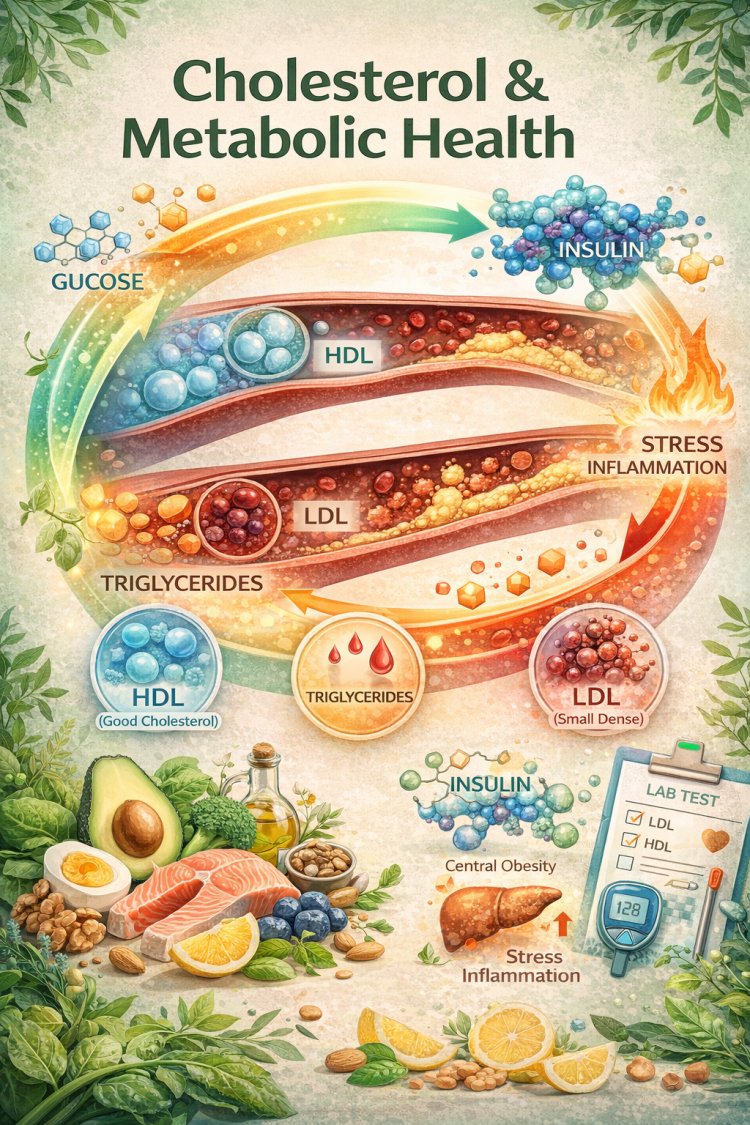
For decades, cholesterol has worn the villain badge in medicine.
High cholesterol? Cut fat.
High LDL? Start a statin.
Heart disease? Blame cholesterol.
But here’s the uncomfortable truth: cholesterol alone is a very poor predictor of metabolic health. In my clinical practice, I routinely see people with “normal” cholesterol who are metabolically unwell—and people with “high” cholesterol who are energetic, resilient, and inflammation-free.
So let’s clear the noise. To truly understand cholesterol, we must look at it in context, not isolation—within the larger picture of metabolic health.
What Exactly Is Cholesterol?
Cholesterol is not a toxin. It is not inherently “bad.”
It is a vital structural molecule that your body depends on every single day. Cholesterol is essential for:
-
Cell membrane integrity
-
Hormone production (estrogen, progesterone, testosterone, cortisol)
-
Vitamin D synthesis
-
Brain and nerve function
-
Bile acid formation for digestion
In fact, 70–80% of the cholesterol in your body is produced by your liver, regardless of dietary intake
Which begs the question:
If cholesterol is so essential, why did it become public enemy number one?
Where the Cholesterol Story Went Wrong
Traditional medicine focused heavily on total cholesterol and LDL numbers, operating on a simple assumption:
Higher cholesterol = clogged arteries = heart disease
But heart disease is not a plumbing problem. It is an inflammatory, metabolic, and hormonal problem.
Cholesterol does not randomly stick to artery walls. It shows up where damage already exists. Think of cholesterol as a firefighter, not the arsonist
then context was lost, cholesterol was blamed for problems it was actually responding to.
Metabolic Health Changes How Cholesterol Behaves
Two people can have the same LDL number and completely different cardiovascular risk. What determines the difference?
Metabolic health.
Metabolic health reflects how well your body:
-
Handles glucose
-
Uses insulin
-
Produces cellular energy
-
Manages inflammation
-
Processes fats
When metabolic health is poor, cholesterol particles behave very differently—and become more dangerous.
Insulin Resistance: The Missing Link in Abnormal Cholesterol
Insulin resistance is one of the most important and most ignored drivers of unhealthy cholesterol patterns.
When insulin resistance develops:
-
The liver overproduces VLDL (triglyceride-rich particles)
-
Triglycerides rise
-
HDL drops
-
LDL particles become small and dense
This pattern is far more dangerous than a mildly elevated LDL alone. In fact, many heart attacks occur in people with “normal” LDL but significant insulin resistance
Why Triglycerides Matter More Than Total Cholesterol
If I had to choose one lipid marker that best reflects metabolic health, it would be triglycerides.
High triglycerides often signal:
-
Excess refined carbohydrate intake
-
Poor insulin sensitivity
-
Fatty liver
-
Chronic inflammation
A simple clinical ratio I often use:
Triglycerides ÷ HDL
-
Ideal: < 2
-
Concerning: > 3
-
High risk: > 4
This ratio often predicts cardiovascular risk better than LDL alone
LDL Is Not One Thing
Here’s something most people are never told:
LDL comes in different particle sizes.
-
Large, buoyant LDL → relatively benign
-
Small, dense LDL → highly atherogenic (more likely to penetrate artery walls)
What shifts LDL toward the dangerous type?
-
Insulin resistance
-
High sugar intake
-
Refined carbohydrates
-
Chronic stress
-
Inflammation
Not saturated fat alone
Why Lowering Cholesterol Without Fixing Metabolism Backfires
Aggressively lowering cholesterol numbers—without addressing metabolic health—creates blind spots.
I see this pattern often:
-
LDL lowered with medication
-
Triglycerides remain high
-
Blood sugar continues to rise
-
Waist circumference increases
-
Energy declines
The labs may look “better,” but the person is getting sicker.
Metabolic health cannot be medicated into existence. It must be restored
Cholesterol in Women: An Important Nuance
In women, cholesterol often rises during:
-
Perimenopause
-
Menopause
-
Chronic stress
-
Thyroid dysfunction
This is not random.
As estrogen declines, the body compensates by:
-
Increasing cholesterol availability for hormone production
-
Altering lipid transport
Suppressing cholesterol without addressing these hormonal and metabolic shifts can worsen fatigue, brain fog, and weight gain.
Context matters—especially for women over 35
The Real Goal: Metabolic Flexibility
The healthiest people are not those with the lowest cholesterol.
They are the ones with:
-
Stable blood sugar
-
Low inflammation
-
Efficient fat metabolism
-
Strong mitochondrial function
-
Good muscle mass
-
Restorative sleep
When metabolic health improves, cholesterol often self-corrects—or becomes far less dangerous
Food Matters—But Not in the Way You Were Told
Cutting fat blindly is not the answer.
What truly improves cholesterol patterns:
-
Reducing refined carbohydrates
-
Eliminating ultra-processed foods
-
Prioritizing protein
-
Supporting gut and liver health
-
Improving sleep and circadian rhythm
-
Managing stress and cortisol
-
Building muscle
This is why two people can eat the same food—and have very different cholesterol response
So, When Should Cholesterol Concern Us?
Cholesterol becomes concerning when it exists alongside:
-
Insulin resistance
-
Elevated fasting insulin
-
High triglycerides
-
Low HDL
-
Fatty liver
-
Elevated CRP
-
Central obesity
-
Poor sleep and chronic stress
It’s not one number—it’s the pattern
Dr. Priya’s Insight
Cholesterol is a messenger, not the enemy.
When I see abnormal cholesterol, I don’t ask, “How do we lower this number?”
I ask, “What is the body trying to compensate for?”
Because the body is intelligent. It adapts before it breaks. If we listen early—through the lens of metabolic health—we can reverse disease, not just suppress markers
A Gentle Reminder
If you’ve been told:
-
“Your cholesterol is high, you must be unhealthy,” or
-
“Just take this pill and don’t worry,”
Pause. Ask deeper questions.
True health is not about chasing perfect lab values. It’s about restoring balance—cell by cell, system by system.
And cholesterol, when understood correctly, becomes a guide—not a threat.





Dr. Priya Vasudevan M.D, AB. Dip ABLM